

 Čeština
 Deutsch
 Română
Best Firewood: Oak, Hornbeam, Beech, or Kiln-Dried Logs?
Kiln-dried beech is the best firewood for wood-burning stoves; it burns slowly, produces sustained high heat, and creates minimal ash or creosote.
Whether you heat your home with a log burner, a wood-burning stove, or an open fireplace, the firewood you choose determines how much heat you get, how long each log lasts, and how clean your flue stays. This guide compares the four most popular hardwood species, oak, hornbeam, beech, and birch, and explains why kiln drying makes a bigger practical difference than most buyers realise. It also covers the Ready to Burn scheme, how to check moisture content before you buy, and what creosote has to do with the logs you choose.
What Is the Best Firewood for a Wood-Burning Stove?
Kiln-dried beech is the best all-round firewood: it burns slowly at high heat, produces very little ash, and its moisture content is reliably below 20% , the threshold for efficient combustion.
Beech combines the two qualities that matter most in a firewood: density and dryness. Its tight grain structure means it releases heat gradually over a long burn rather than flaring up and dying down quickly. When kiln dried, it lights reliably, sustains a clean flame, and produces significantly more usable heat per log than softer or wetter alternatives.
Kiln-dried oak is a close second, offering a similarly slow burn and excellent heat output. Birch burns hot but fast , useful for quickly raising the temperature of a cold stove, but less efficient for sustained heating across an evening. Hornbeam sits between the two extremes: steady and reliable, and technically the densest of the four species, though it burns faster in practice than either beech or oak.
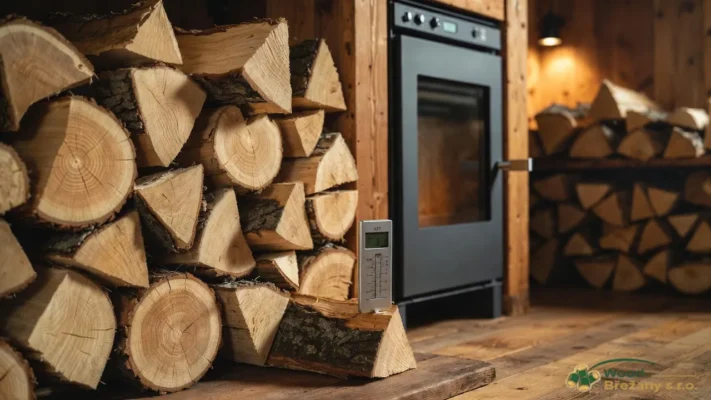
How Do Oak, Beech, Hornbeam, and Birch Compare as Firewood?
Beech and oak lead on heat output and burn time; birch burns hottest but fastest; hornbeam offers the highest density of the four species but is underrated and underused in most households.
The table below compares the four species on the metrics that matter most for practical home heating. BTU figures reflect cord measurements at 20% moisture content, based on US Forest Products Laboratory data.
| Species | Heat Output (BTU/cord approx.) | Density (kg/m³ approx.) | Burn Rate | Moisture Threshold | Best Use |
|---|---|---|---|---|---|
| Beech | ~27.5 million | 710 | Slow | Below 20% | All-evening heating in stoves |
| Oak | ~29 million | 720 | Slow | Below 20% | Long, sustained fires |
| Hornbeam | ~30 million | 800 | Medium-slow | Below 20% | High-demand stoves and heating |
| Birch | ~23 million | 600 | Fast | Below 20% | Kindling and quick heat boosts |
One important nuance the table does not fully capture: hornbeam is technically the densest of these four species, which is why its BTU figure sits highest, but it burns noticeably faster than oak or beech in practice, making it less efficient for overnight or all-evening use. Beech is the sweet spot between density, burn duration, and consistent availability. For most wood-burning stove owners, kiln-dried beech delivers the most predictable performance week after week.
What Is the Best Firewood for Maximum Heat Output?
Hornbeam delivers the highest BTU output of European hardwoods; kiln-dried oak is the best balance of heat, burn time, and availability for most households.
Hornbeam’s density of approximately 800 kg/m³ gives it a raw heat advantage over all three of its competitors here. However, “maximum output” in practice means sustained heat over time, not just peak temperature, and on that measure, oak edges ahead because its slower combustion rate stretches that energy across a longer burn.
Beech is only marginally behind oak on raw BTU but is considerably more consistent in quality because its grain structure is more uniform and it responds very well to kiln drying. If you want the most heat from a single load, and your stove can handle aggressive burning, hornbeam is the answer. If you want the most heat per evening with minimal attention, kiln-dried oak or beech is the more practical choice.
What Moisture Content Should Firewood Have for the Best Burn?
Firewood should be below 20% moisture for efficient burning. Wetter wood wastes energy evaporating water, cutting usable heat output by up to 25% compared to properly dried logs.
This 20% figure is the industry standard used by the Ready to Burn scheme in the UK; logs certified under this scheme are independently verified at below 20% moisture content. To put that in practical terms: a log at 30% moisture produces roughly a quarter less usable heat than the same log dried to 15%. The water locked inside the wood has to be cooked off before combustion can proceed efficiently, which is why wet logs hiss, smoulder, and blacken your stove glass rather than burning cleanly. The European Biomass Association has confirmed in its reports on solid biomass quality that lower moisture content directly improves calorific efficiency and combustion stability , the relationship is not marginal, it is fundamental.
What Is the Difference Between Kiln-Dried and Seasoned Firewood?
Kiln-dried logs reach below 20% moisture in 48–72 hours; air-seasoned logs take 18–24 months to reach the same level , and may never fully get there in a wet northern European winter.
Seasoning relies on airflow and time. Stack beech or oak outdoors in a dry, ventilated spot, and after one to two years it will approach optimal moisture levels , assuming the weather cooperates. The problem is consistency: poorly stacked or partially covered logs can remain above 25% moisture even after two years, and there is no reliable way to know without testing each batch individually. Kiln drying eliminates this uncertainty entirely.
The controlled environment of a commercial kiln brings logs to a consistent, certified moisture level in a matter of days. Every log in the bag lights easily, burns cleanly, and delivers the heat output you paid for. The moisture content is not an estimate or an aspiration , it is a verified measurement.
Does Kiln-Dried Firewood Produce Less Creosote Than Seasoned Wood?
Yes. Kiln-dried firewood produces significantly less creosote than wet or under-seasoned wood because low-moisture combustion runs hotter and cleaner, leaving fewer unburned hydrocarbons to condense in the flue.
Creosote forms when combustion gases cool before fully burning off , and this happens most readily when a fire is starved of heat, which is exactly what wet wood causes. When a log contains excessive moisture, a significant portion of its energy goes toward evaporating that water rather than sustaining the flame. This keeps flue temperatures low, which is precisely the condition under which creosote deposits accumulate fastest.
Kiln-dried hardwood — particularly beech and oak dried to 12–15% moisture , burns hot enough from the outset to keep flue gases warm as they rise, dramatically reducing the rate of condensation and deposit. In practical terms, stoves burning kiln-dried hardwood consistently tend to require sweeping once per heating season, while stoves burning wet or poorly seasoned wood often need attention twice a season and carry a meaningfully higher risk of chimney fires. Less creosote also means cleaner stove glass, which is one of the most common complaints from log-burner owners using under-dried fuel.
What Is the Ready to Burn Scheme and Why Does It Matter?
The Ready to Burn scheme is a UK certification that guarantees firewood contains 20% moisture or less, the legal threshold for domestic wood fuel sales under the Clean Air Strategy.
Introduced as part of the UK government’s effort to reduce particulate emissions from domestic solid fuel burning, the Ready to Burn scheme requires firewood sold in volumes under 2m³ to be independently certified at or below 20% moisture before it can carry the scheme’s logo. This matters for buyers for two reasons. First, it removes all guesswork: a bag bearing the Ready to Burn logo has been tested, not just claimed to be dry. Second, it reflects a legal requirement , selling uncertified wet wood in small volumes is now prohibited under UK solid fuel regulations.
For buyers in Germany, Austria, and other parts of Central Europe, equivalent standards exist under the EN Plus certification framework for wood pellets and increasingly for firewood more broadly. The underlying principle is the same: dry fuel means cleaner combustion, lower emissions, and less maintenance for the homeowner. When comparing suppliers, asking whether their product is Ready to Burn certified , or equivalent — is the single most useful question you can ask.
How Do I Check the Moisture Content of Firewood Before Buying?
Use a handheld wood moisture meter ,available for under £15 ,to check multiple logs from different parts of the batch. Insert the probes into a freshly split surface for the most accurate reading.
The most important practical detail here is where you take the measurement. Moisture meters read the surface of the wood, and the outer face of a seasoned log is almost always drier than the interior. Splitting a log and testing the freshly exposed cross-section gives you a far more reliable figure. A reading below 20% on a split surface confirms the log is ready to burn efficiently.
A reading between 20% and 30% means the log will burn, but with reduced output and increased smoke. Above 30%, the log will struggle to sustain combustion at all and should not be used in a stove. Buying kiln-dried logs from a certified supplier removes the need to test every batch , but a moisture meter remains a worthwhile tool for anyone buying large volumes or purchasing from a new supplier for the first time. Prices start at around £10–£15 for a basic model, which pays for itself after a single batch of wet wood avoided.
Is Oak or Beech Better for a Wood-Burning Stove?
Both are excellent, but beech edges ahead for log burners because it produces more consistent heat across the full burn , oak has a slightly higher peak BTU but can vary more between batches.
Oak’s reputation is well deserved: it is dense, long-burning, and widely available. However, oak can be more variable in quality because the species is slower to season and is sometimes sold under-dried. When both are kiln dried to the same moisture level, beech tends to perform more consistently because its grain structure is more uniform. For a stove where you want steady, manageable heat for several hours, kiln-dried beech is the more predictable choice. If you are burning in an open fireplace and want a long-lasting, visually attractive fire with strong ember formation, kiln-dried oak is hard to beat. For households that only want to stock one species, beech is the safer recommendation.
Why Is Oak Considered a Premium Firewood?
Oak is a premium firewood because its high lignin content produces slow, stable combustion and long-lasting embers ideal for overnight heating.
Lignin is the structural compound that gives hardwoods their density, and oak contains it in particularly high concentrations. This is what allows oak to maintain a consistent burn rate rather than flaring and collapsing, and it is why oak embers hold heat long after the visible flame has died down , a quality that makes it especially well suited to wood-burning stoves used for overnight heating. Oak also has a satisfying aesthetic quality in an open fireplace: it burns steadily, produces a warm orange flame, and holds its form visually across a long burn.
The main caveat is that fresh oak contains very high moisture , sometimes exceeding 50% , which means it absolutely requires proper kiln drying or extended seasoning before it performs as described. Green or under-dried oak is one of the worst-performing firewoods available; properly dried oak is one of the best.
How Long Does Beech Firewood Burn Compared to Birch?
A kiln-dried beech log burns approximately 40–50% longer than an equivalent birch log at the same moisture content, making beech considerably better value per log for sustained heating.
This difference comes down to density. Beech has a specific gravity of around 0.72, compared to birch at roughly 0.60 , meaning a beech log of the same physical size contains significantly more combustible material. Birch is not without its uses: its thin, papery bark catches fire easily and makes it the best choice for kindling or for quickly boosting heat in a cold stove. But for the main body of your fire, burning birch exclusively is an expensive way to heat a room. A practical approach used by many experienced stove users is to use birch as a starter , it catches quickly and raises the stove temperature fast — and then transition to beech or oak for the sustained burn.
Is Hornbeam the Best Hardwood Firewood for High-Demand Stoves?
Hornbeam is Europe’s densest common firewood at approximately 800 kg/m³, but burns faster in practice than oak or beech, making it best for high-demand stoves rather than slow overnight burns.
Hornbeam, known in Central Europe as Carpinus betulus, burns slower than many species. For customers in Germany or Austria, our Buy Hornbeam Firewood Online provides reliable winter heat.
Customers comparing species often reference our guide on Top 5 Firewood Types Ranked by Heat Output to understand burn characteristics before placing an order.
Why Is Beech Considered the Best Firewood for Home Heating?
Beech burns hotter and longer than most hardwoods due to its exceptional density and grain uniformity, making it the most efficient firewood for sustained home heating in stoves and log burners.
Three properties combine to make beech the top pick for most wood-burning stove users. Its density means it packs more energy into each log than lighter hardwoods. Its grain uniformity means it burns predictably rather than spitting or collapsing suddenly mid-burn. And its response to kiln drying is particularly strong: beech reaches very low moisture levels in the kiln and holds them well in storage, which means the certified moisture content you buy is the moisture content you burn. When you purchase kiln-dried beech from a reputable certified supplier, you are buying a guaranteed performance level , not a variable natural product that depends on how well it was stored before reaching you.
What Are the Benefits of Kiln-Dried Logs Over Seasoned Wood?
Kiln-dried logs burn hotter, produce less smoke, and build up less creosote than seasoned wood because their moisture content is reliably below 20% , not an estimate, but a verified standard.
The practical benefits extend well beyond heat output alone. Less smoke means less creosote depositing in your flue liner, which reduces the frequency of chimney sweeping and lowers the risk of chimney fires. Less smoke also means cleaner stove glass , one of the most common complaints from log-burner owners using wet or under-seasoned wood.
Because kiln-dried logs light more easily and sustain a higher combustion temperature, you also use less kindling and fewer fire lighters, which adds up meaningfully over a full heating season. For users in urban areas across the UK, Germany, and Central Europe, the air quality dimension is increasingly important as well: the European Environment Agency has confirmed that residential solid fuel combustion is a significant contributor to particulate matter levels, and dry hardwood produces measurably lower particulate emissions than wet logs.
For customers who require mixed loads, we also offer Buy Mixed Firewood Online for flexible heating.
How Do I Get the Most Heat from My Firewood?
Use kiln-dried hardwood below 20% moisture, build your fire with a top-down structure, and run your stove at the manufacturer’s recommended airflow setting to avoid smouldering.
Three practical habits make the biggest difference. Store your logs indoors or in a covered log store for at least 48 hours before burning , bringing logs to room temperature dramatically improves how they light and sustain a flame. Use a top-down fire-lighting method, with kindling placed on top of the main logs rather than underneath, to establish a strong flame before introducing larger pieces. And resist the temptation to choke the airflow too aggressively to “stretch” the fuel , a smouldering, oxygen-starved fire produces more creosote and less usable heat than one burning cleanly at the correct temperature. The goal is a bright, steady flame, not a slow smoulder.
Which Firewood Is Right for Your Heating Situation?
The right firewood depends on your priority, but kiln-dried beech or oak covers most situations , and whatever species you choose, kiln-dried is always preferable to air-seasoned.
For the longest, most consistent heat output in a wood-burning stove or log burner, kiln-dried beech is the clear leader. For a visually impressive, long-lasting open fire with exceptional ember formation, kiln-dried oak is ideal. For high-demand stoves where maximum heat per log is the priority, kiln-dried hornbeam is an underrated choice. And for kindling or a quick heat boost at the start of a session, kiln-dried birch is unmatched. Whatever species you choose, kiln dried is always preferable to air-seasoned: the moisture content guarantee alone is worth the small price premium. Wet wood is not cheap firewood — it is expensive fuel that delivers poor results and accelerates the maintenance schedule on your stove and flue.
Where to Buy Quality Kiln-Dried Firewood
When buying kiln-dried logs, look for suppliers who state the moisture content explicitly , ideally certified under the Ready to Burn scheme in the UK or an equivalent European standard — and who specialise in hardwood species rather than selling a generic unlabelled mix. Reputable suppliers will be transparent about species and will offer beech, oak, hornbeam, and birch as distinct product lines, so you know exactly what you are burning and what performance to expect. If a supplier cannot tell you the moisture content of their logs, that is a meaningful warning sign.
Wood-Břežany offers a full range of kiln-dried hardwood logs, including beech, oak, hornbeam, and birch, all certified below 20% moisture content. Their kiln-dried beech and hornbeam logs are particularly well regarded for stove and log burner use, and cross-border delivery is available across Europe.
Where can you buy the best firewood online in Europe?
Order certified hardwood logs directly from WOOD Břežany s.r.o. with transparent sourcing and cross border delivery options.
We operate from Břežany 241, 671 65 Břežany, Czech Republic. Our European customers can browse the Shop, review company information on About Us, and contact our team via Contact Us.
We also provide guidance on how to choose the right firewood for your fireplace, available in our knowledge hub under How to choose the right firewood for your fireplace.
Frequently Asked Questions
What wood burns the longest in a fireplace? Hornbeam and oak burn longer than most European hardwoods due to their high density and slower combustion rate when properly dried to below 20% moisture.
Is kiln-dried firewood better than seasoned wood? Kiln-dried logs provide guaranteed low moisture and are ready to burn immediately; seasoned wood may offer a cost advantage but cannot guarantee consistent moisture content without testing.
How dry should firewood be before burning? Firewood should contain 20% moisture or less , this is the threshold confirmed by European combustion standards and required under the UK Ready to Burn scheme for legally sold wood fuel.
Does oak firewood need seasoning? Yes. Fresh oak can contain over 50% moisture and must be kiln dried or air-seasoned for at least 18–24 months before it will burn efficiently.
Which firewood produces the least smoke? Kiln-dried beech or oak produces the least smoke of the common hardwoods because their low moisture content supports complete, high-temperature combustion with minimal unburned particulate.
Is hornbeam good for wood stoves? Hornbeam is excellent for stoves, particularly high-output models, because it produces strong, steady heat and exceptionally long-lasting embers , though it burns through its fuel load faster than beech or oak.