

 Čeština
 Deutsch
 Română
Hardwood vs Softwood Firewood: Which Burns Best
When the temperature drops across Europe and the fire needs to last all night, the hardwood vs. softwood firewood debate matters more than most people realise. The type of wood you burn affects everything from heat output and burn duration to chimney safety and how often you restock the log pile. At Wood-Břežany, we have spent years helping homeowners, farmers, and businesses across the continent choose the right firewood for their needs, and this guide cuts straight to what actually counts.
Not sure whether to buy hardwood or softwood firewood this heating season? At Wood-Břežany, we supply premium kiln-dried and seasoned firewood across Europe, including Buy Beech Firewood Online, oak firewood, hornbeam, alder, pine, and mixed varieties. Every log is selected for optimal moisture content, consistent density, and clean burning performance. Whether you heat a home, a stove, or a fireplace, we have the right wood for you. Order directly from our shop and get reliable delivery across Europe.
What Is the Real Difference Between Hardwood and Softwood Firewood?
Hardwood comes from slow-growing deciduous trees and is denser than softwood, which determines how long and how hot it burns.
The botanical distinction is straightforward. Hardwood species include oak, beech, hornbeam, ash, birch, and alder. They grow more slowly, which produces a denser cellular structure. Softwood species include pine, spruce, fir, and cedar. They grow faster and are less dense. That single difference in density shapes almost every aspect of how each type performs in a fire.
According to The Old Farmer’s Almanac, “hardwoods generally make for better firewood than softwoods because of their density and comparatively low levels of sap or pitch.”
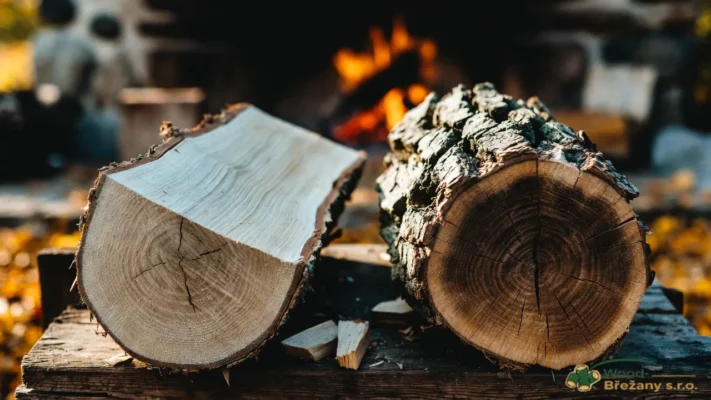
How Much Heat Does Hardwood vs. Softwood Actually Produce?
Hardwoods average 21.3 million BTUs per cord burned, while softwoods average 15.4 million BTUs per cord, roughly a 38% difference in usable heat.
Looking at species comparisons, hardwoods on the list average 21.3 million BTUs per cord of wood burned. Softwoods, on the other hand, average 15.4 million BTUs per cord. While hardwood’s higher density makes it more difficult to light initially, it is also what allows it to release more heat. There is more material there, and when that material is burned, it delivers more energy. Hardwood also tends to have lower moisture content than softwood when properly seasoned, and moisture in wood saps away heating energy because it has to be boiled off before the wood can radiate heat effectively.
One important nuance: pound for pound, and dried to the same moisture content, hardwoods and softwoods have very similar BTU values. A ton of oak will provide roughly the same amount of heat as a ton of willow. The advantage of hardwood is that its density means you get significantly more weight (and therefore more energy) per log or per cord. According to HY-C’s 2025 firewood comparison, this density advantage is the primary reason hardwood dominates professional heating applications across Central Europe.
| Wood Type | Category | Approx. BTU per Cord | Burn Duration | Creosote Risk | Best Use |
|---|---|---|---|---|---|
| Oak | Hardwood | 24-29 million | Very long | Low | Primary heating, overnight burns |
| Beech | Hardwood | 21-24 million | Long | Low | Home heating, fireplaces |
| Hornbeam | Hardwood | 22-25 million | Very long | Very low | Stoves, sustained heating |
| Ash | Hardwood | 20-23 million | Long | Low | Fireplaces, stoves |
| Birch | Hardwood | 18-20 million | Medium-long | Low | Quick warm-up, general use |
| Alder | Hardwood | 17-19 million | Medium | Low | Smoking, general use |
| Pine | Softwood | 14-17 million | Short-medium | Moderate-high | Kindling, quick fires |
| Spruce | Softwood | 13-16 million | Short | Moderate | Kindling only |
Why Is Hardwood Firewood Better for Home Heating in Europe?
Hardwood firewood burns longer, produces steadier heat, and creates less creosote than softwood, making it the best choice for European home heating.
Hardwoods are denser and contain more fuel mass per cord. This allows them to burn more slowly and produce longer-lasting coals compared to lightweight softwoods like pine or spruce. For a wood-burning stove running through a Central European winter, that sustained coal bed means fewer refills overnight and more consistent room temperature across the heating hours.
“Dense hardwoods like oak, hickory, and locust are best for overnight burns because they produce long-lasting coals and steady heat output.” (Modern Survival Blog, 2025)
Beech produces a steady, clean flame with excellent coaling quality, making it ideal for wood-burning stoves and closed fireplaces across Germany, the Czech Republic, Romania, and Poland. Hornbeam is among the densest hardwoods available in Europe, producing outstanding long-duration heat with minimal smoke. For a side-by-side comparison of the top European species, our guide on the best firewood: oak, hornbeam, and beech covers each one in detail.
Browse our full range: Buy Beech Firewood Online | Buy Hornbeam Firewood Online
When Is Softwood Firewood Worth Using?
Softwood firewood is best used as kindling or for short fires. It ignites faster than hardwood but burns out quickly and risks creosote buildup.
This does not mean softwood is without value. Pine sells steadily to customers who use it to get a fire going quickly before adding hardwood for sustained heat. The practical approach many experienced wood burners take is to start with softwood and then load the stove with hardwood logs for the main burn. Starting your fire with softwoods like pine and then adding hardwoods produces a long-lasting, efficient result with less frustration at the ignition stage.
The key risk with softwood is creosote buildup in chimneys. Because pine contains more resins, burning wet pine significantly accelerates creosote deposits. Dry pine, however, makes excellent kindling. At Wood-Břežany, our kiln-dried pine is tested to arrive below 18% moisture content, which minimises creosote risk and makes it safe for use as kindling in enclosed stoves.
Does Softwood Create More Creosote Than Hardwood?
Yes. Softwood produces more creosote than hardwood because of higher resin content and faster, cooler combustion, especially when moisture content exceeds 20%.
Creosote is a tar-like residue that accumulates inside chimneys and flue pipes. It forms when wood combustion is incomplete, which happens most often with wet wood and low-burning fires. Softwood species like pine and spruce contain significantly more resin than hardwoods, and that resin burns incompletely at lower temperatures, depositing creosote faster. According to the Chimney Safety Institute of America, creosote buildup is the leading cause of chimney fires, and the risk is substantially higher with resinous softwoods burned at low temperatures.
The practical takeaway is clear: if you use softwood at all, keep moisture below 18%, use it only at ignition or for short hot burns, and have your chimney swept at least once per heating season.
Which Hardwood Species Is the Best Firewood to Buy Online?
Oak, beech, and hornbeam consistently rank as Europe’s top three hardwood firewood choices for heat output, burn time, and low creosote production.
Here is how the leading European species compare:
- Oak delivers around 24-29 million BTUs per cord and produces exceptional coals, the top choice for overnight heating.
- Beech burns hot and clean with a beautiful flame, popular across Central and Western Europe for both stoves and open fireplaces.
- Hornbeam is the densest native European hardwood and burns the longest of the three with very low creosote production.
- Ash is widely praised for burning well even when slightly less seasoned than other species.
- Birch ignites more easily than oak and produces a bright, lively flame, though it burns somewhat faster and works best combined with a denser species for sustained heating.
- Alder burns cleanly with a mild aroma and is particularly popular for smoking food as well as general home use.
For a deeper comparison by species, our guides on ash vs oak firewood and the top 5 firewood types ranked by heat output are useful starting points.
For customers who want flexibility across species, our Buy Mixed Firewood Online combines species for a practical all-season solution. If you want firewood ready to burn immediately on delivery, our Buy Dried Firewood Online arrives with moisture content below 20%, which is the threshold recommended by the European Biomass Industry Association for clean and efficient combustion.
How Do You Choose the Right Firewood for Your Fireplace or Stove?
Choose firewood based on your appliance type, how long you need it to burn, and moisture content below 20% for safe, efficient combustion.
For a closed wood-burning stove used as a primary heat source through winter, dense hardwood is the right call. The long burn time means fewer refills and better overnight performance. For an open fireplace used occasionally for ambiance and supplemental warmth, a mix of birch or alder alongside beech works well. For pure kindling and fire-starting, dry softwood is ideal, and it is worth keeping a separate supply on hand.
Always check moisture content before buying. Even the highest-BTU wood will not burn efficiently if it is wet. A moisture reading below 20% is the target for maximum heat output and less creosote. Our guide on how to choose quality firewood for heating covers the full selection process in detail.
How Long Does Hardwood Firewood Take to Season Before Burning?
Hardwood firewood typically takes 12 to 24 months to air-season to below 20% moisture content, depending on species and storage conditions.
Denser hardwoods like oak and hornbeam take the longest, often requiring 18-24 months of open-air stacking in a covered, well-ventilated location. Ash and birch season more quickly, typically reaching burnable moisture levels within 12 months. Kiln-drying dramatically accelerates this process, bringing moisture content below 20% in a matter of days rather than seasons. This is why our kiln-dried firewood products arrive ready to burn immediately, with no waiting period and consistent moisture readings across every batch.
Buy Ready-to-Burn Dried Firewood Online
Is Birch a Hardwood or Softwood, and Is It Good Firewood?
Birch is a hardwood. It produces around 18 to 20 million BTUs per cord, ignites more easily than oak, and is an excellent everyday firewood, particularly when combined with a denser species for overnight burns.
Birch lights more readily than oak or hornbeam, makes less mess than pine, and its characteristic white bark is naturally water-resistant, giving it a slight advantage in damp storage conditions. The trade-off is burn time: birch burns faster than oak or beech, so it works best as a primary fuel in appliances that are refuelled regularly, or combined with denser species for overnight stoves. Our full comparison on birch vs ash vs oak firewood helps you decide which species suits your heating setup best.
What Are the Key Differences Between Hardwood and Softwood Firewood?
- Hardwood firewood produces roughly 38% more heat per cord than softwood, averaging 21.3 million BTUs versus 15.4 million BTUs, based on published species comparison data.
- Density is the defining factor. Denser wood holds more energy per unit volume, burns longer, and produces better coals.
- Softwood burns faster and ignites more easily, making it ideal for kindling but not for sustained heating through a winter night.
- Creosote risk is higher with softwood, particularly when moisture content exceeds 20%. Always use properly dried firewood regardless of species.
- Oak, beech, and hornbeam are the top performers for European home heating in wood-burning stoves and fireplaces.
- Moisture content below 20% matters as much as wood species when it comes to efficiency, safety, and chimney health.
- At Wood-Břežany, every product in our firewood shop is sourced for quality, properly seasoned, and available for delivery across Europe.
Frequently Asked Questions
What burns hotter, hardwood or softwood firewood?
Hardwood burns hotter per cord, averaging 21.3 million BTUs compared to softwood’s 15.4 million BTUs. The reason is density: hardwood packs more combustible material into each log, producing more heat and longer-lasting coals.
Is softwood firewood safe to burn indoors?
Dry softwood with moisture content below 18% can be burned indoors as kindling. The risk is creosote buildup in the chimney, which increases when wet or resinous softwood is used as the primary fuel. Regular chimney cleaning is essential if softwood forms part of your fuel mix.
Which hardwood firewood lasts the longest in a wood stove?
Hornbeam and oak last the longest due to their exceptional density and strong coaling quality. Both species are rated for sustained overnight burns with very low creosote production and are available to order online from Wood-Břežany.
Buy Hornbeam Firewood Online | Oak Firewood for Sale
How dry should firewood be before burning?
Firewood should have a moisture content of 20% or below before burning. Above this level, a significant portion of combustion energy is lost evaporating water rather than producing heat, reducing efficiency and increasing smoke and creosote deposits in the flue.
Can you mix hardwood and softwood when burning?
Yes, and it is a practical strategy used by many experienced wood burners. Use dry softwood to start the fire quickly, then add dense hardwood logs for a long, steady burn. Our mixed firewood products are designed with exactly this combined approach in mind.
Where can I buy quality hardwood firewood online in Europe?
Wood-Břežany (woodbrezany.com) supplies premium dried hardwood firewood including beech, oak, hornbeam, ash, birch, alder, and mixed varieties, with delivery across European countries. The full range is available to browse and order from the online shop.
What is the best firewood for a wood-burning stove in the UK?
Oak, beech, and hornbeam are the top recommendations for wood-burning stoves in the UK. All three produce high BTU output, low creosote, and excellent coaling quality, and are available kiln-dried and ready to burn from Wood-Břežany.
Does softwood create more creosote than hardwood?
Yes. Softwood produces more creosote than hardwood because of higher resin content and faster, cooler combustion, especially when moisture content exceeds 20%. The Chimney Safety Institute of America identifies creosote buildup as the leading cause of chimney fires.
How long does hardwood firewood take to season before burning?
Hardwood firewood typically takes 12 to 24 months to air-season to below 20% moisture content, depending on species and storage conditions. Kiln-dried firewood bypasses this wait and arrives ready to burn immediately.
Is birch a hardwood or softwood, and is it good firewood?
Birch is a hardwood. It produces around 18 to 20 million BTUs per cord, ignites more easily than oak, and is an excellent everyday firewood, particularly when combined with denser species for sustained overnight burning.
References
- The Old Farmer’s Almanac: Best Firewood, Heat Values and Wood-Burning Tips
- HY-C Blog: Hardwood vs. Softwood, Which Firewood Is Better to Burn? (March 2025)
- Modern Survival Blog: Best Wood for Heating, BTU Firewood Chart (2025)
- We Love Fire: Which Is Better, Hardwood or Softwood?
- Environmental Chimney Service: What Firewood Burns the Hottest?
- Living Green and Frugally: Which Firewood Gives the Most Heat, BTU Rating Chart (February 2025)
- Chimney Safety Institute of America: Creosote and Chimney Fire Prevention