

 Čeština
 Deutsch
 Română
 Polski
 Italiano
 Español
 Nederlands
 Magyar
 Slovenčina
 Slovenščina
 Hrvatski
How long does a bag of wood briquettes last?
If you are asking how long a bag of wood briquettes lasts, the honest answer from our own yard logs is one to three evenings per 10 kg bag in a typical stove, depending on how hard you fire it. That range surprises people. Some customers burn through a bag in a single long Saturday by the fire; others nurse one across a week of mild autumn evenings. The number moves with your stove, your house and the type of briquette you buy, and once you understand those levers, you stop guessing and start planning your wood briquettes order with confidence.
Key takeaways:
- A 10 kg bag lasts one to three evening fires in a standard stove.
- One briquette burns for one to two hours; dense night briquettes glow for up to eight hours.
- Briquettes hold 4.8 to 5.0 kWh per kg, roughly 20% more energy than seasoned logs.
- A four-hour evening fire consumes about eight to ten briquettes.
- Pallet orders cut the price per kg, so bulk buying wins on cost.
How long does a bag of wood briquettes last?
A 10 kg bag of wood briquettes lasts one to three evenings in a typical stove, so most homes use two to four bags a week through winter.
The arithmetic is refreshingly plain. A 5 kW stove working at full output consumes around 1.5 to 2.0 kg of solid fuel per hour, according to Hot Box Stoves, a UK stove specialist. Burn from six in the evening until ten, and you have spent roughly 6 to 8 kg. One 10 kg bag, one good evening, with a little left for the morning coffee fire. Throttle the air control back, and the same bag stretches across two or three shorter, milder evenings. We walk customers through this math every week at our about us page enquiries, and the pattern holds from Yorkshire to Bavaria.
How long does a single wood briquette burn?
One standard wood briquette burns one to two hours at normal settings, while dense night briquettes glow for up to eight hours with the air closed.
Belgian stove retailer Pellet Stove Advantage logs standard hardwood and softwood briquettes at one to two hours per piece. Premium heat logs behave similarly, with Certainly Wood quoting up to four hours for its denser heat briquettes. The outlier is the night briquette, a bark-rich block pressed to smoulder, which holds a low glow for up to eight hours. That is the piece you reach for at 11 pm, not the one you load at 6 pm.
Can you leave briquettes to smoulder overnight safely?
Yes, provided your stove is rated for slow, controlled combustion and you close the air supply properly. Check your stove manual first, sweep the chimney annually, and never overload the firebox before bed.
How many briquettes do you need for one evening fire?
A four-hour evening fire uses eight to ten briquettes at full output, which is close to one 10 kg bag burnt in a single sitting.
Count pieces instead of kilos, and the picture sharpens. Pellet Stove Advantage puts an average evening firing at two to four briquettes per hour, with single briquettes weighing 1 to 2 kg. Our own RUF blocks sit at the heavier end, around 1.5 kg each, so a relaxed evening rarely demands more than a handful. Compare that with kiln-dried logs, where Logan’s Logs measures a normal four-hour burn at five to six 1 kg logs, and you see why briquette users refill less often.
Which factors decide how long a bag of briquettes lasts?
Stove efficiency, air supply, insulation, outdoor temperature, density and moisture content decide how long your bag of briquettes lasts.
Six levers matter, and you control most of them:
- Stove efficiency. Modern stoves convert 70 to 85% of fuel into usable heat. Older open fires throw much of it up the flue.
- Air control. Airflow is the throttle. Closed vents mean a longer, slower burn time.
- Insulation. A sealed living room holds heat, so the stove rests between refills.
- Outdoor temperature. A minus ten February demands double the fuel of a mild October evening.
- Briquette density. The denser the block, the slower and hotter it burns. Our best wood briquettes on the market review explains the differences.
- Moisture content. Quality classes under the ISO 17225-3 standard cap moisture at 10% or below, and briquetting experts like RUF Group press only feedstock below roughly 12%. Damp briquettes hiss, smoke and die early. Keep bags off wet floors, the same discipline we teach in our firewood storage guide.
How long does a bag of wood briquettes last? A 10 kg bag usually lasts between one and three days in a stove that runs every day, which works out to roughly 8 to 9 RUF-style blocks. The exact figure depends on stove size, how hard you run it and the briquette type. This guide gives you the numbers and worked examples so you can plan your weekly and winter order.
How long does one briquette burn?
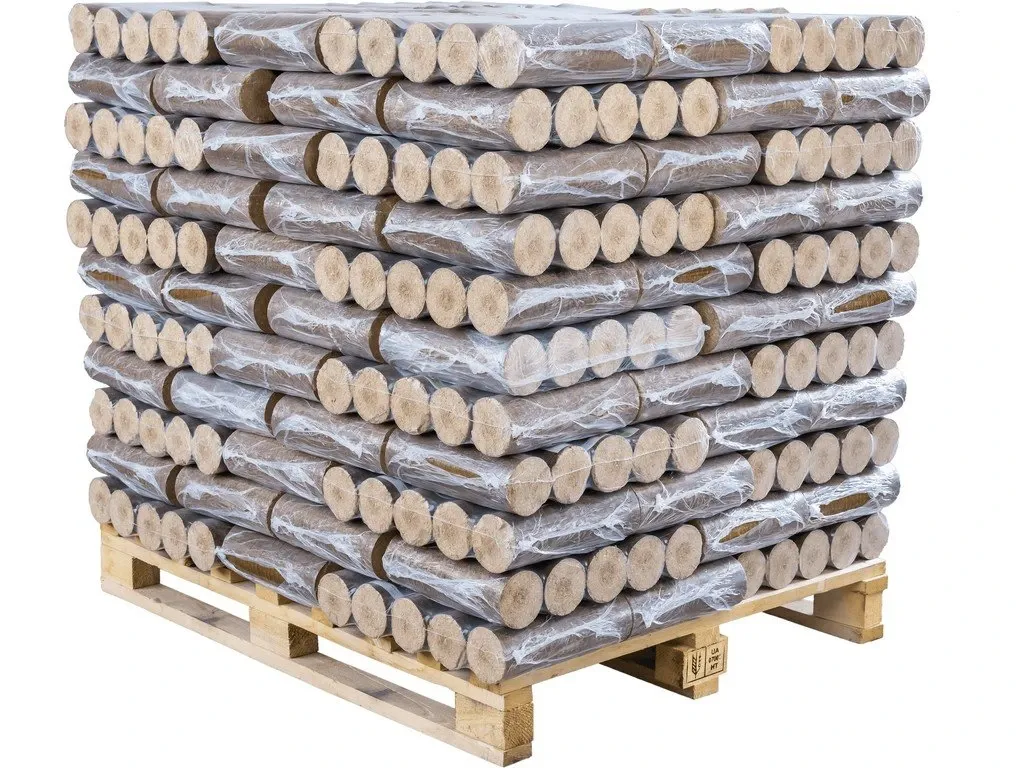
A single wood briquette burns for roughly 2.5 to 6 hours in a closed stove, depending on its shape, density and the air setting. That is a burn time per block, not per bag. A bag holds many blocks, and you normally burn one to three at a time, so the bag lasts much longer than one burn cycle.
Burn time is a trade-off with heat output. With the air control wide open, a briquette burns fast and gives strong heat. With the air closed down, the same briquette burns two to three times longer at a lower output. Quoted burn times usually describe a medium or low air setting.
Our wood briquettes performance guide covers density, moisture and ash in more detail. Here we focus on how those properties turn into days of heating.
Order wood briquettes online today and stretch every bag further.
At WOOD-Břežany s.r.o. we press, pack and ship wood briquettes by the bag and by the full pallet, so households across the UK, Germany, Italy, Poland and Romania can heat through winter without watching the fuel gauge with one eye. Our range covers RUF briquettes, Nestro briquettes and Pini Kay briquettes, all made from compressed, dried sawdust with no chemical binders, only the natural lignin that holds each block together.
Each briquette leaves our plant with a moisture content below 10% and a calorific value near 5.0 kWh per kg, which is why one bag quietly outperforms a heavier load of seasoned logs. Ordering is simple. Pick your type on our shop page, choose bags or a full pallet, and our team arranges delivery. If you are unsure which briquette suits your stove, read our RUF briquette guide first, then contact us for a pallet quote. Bulk buyers get the best price per kg, and cold snaps get a lot less stressful.
Burn time by briquette type
The table shows typical ranges for a single block in a closed stove. Treat them as approximate. Brand, density and your stove all move the result.
| Briquette type | Typical block weight | Typical burn time per block | Best use |
|---|---|---|---|
| RUF (rectangular) | about 1.0 to 1.2 kg | 4 to 5 hours | Steady heat, overnight burns |
| RUF with bark | about 1.0 to 1.2 kg | 3 to 5 hours | Long, even burns at moderate output |
| Nestro (hardwood) | varies by pack | 3 to 5 hours | Stoves and fireplaces, strong heat |
| Pini Kay (hole in centre) | varies by pack | 3 to 4 hours | Quick lighting, high output |
| Peat briquettes | varies by pack | 6 to 8 hours (supplier figure) | Night heating, lower calorific value |
Wood briquettes have a calorific value of about 4.7 to 5.0 kWh/kg, which is higher per kilogram than typical dry firewood at about 4.2 kWh/kg. They are also denser, so a kilogram takes up less space and burns steadily.
How many kilograms per hour does a stove use?
Fuel use is simple physics. Divide the heat your room needs by the stove efficiency and the energy in a kilogram of briquettes.
Fuel per hour (kg) = heat output (kW) / (efficiency x 4.8 kWh/kg)
We use 4.8 kWh/kg for briquettes and 75% for a typical modern stove. These are assumptions, so your real figure will differ somewhat. A stove rated at 8 kW does not burn at 8 kW all day. Most of the time it runs well below its nominal output.
| Stove (nominal output) | Average heat you actually use | Briquettes per hour | Briquettes per 8-hour day |
|---|---|---|---|
| Small, 4 kW | 2 kW | about 0.55 kg | about 4.4 kg |
| Medium, 6 kW | 3 kW | about 0.85 kg | about 6.7 kg |
| Large, 8 kW | 4 kW | about 1.1 kg | about 8.9 kg |
| Very large, 10 kW | 5 kW | about 1.4 kg | about 11 kg |
A single 1.15 kg RUF block at 0.85 kg/h would last about 1.4 hours. In practice a block lasts 4 hours or more because you close the air control and the stove runs at about 1.3 kW. If you run it wide open, expect the shorter figure.
Briquette types compared: burn time and energy table
| Briquette type | Moisture | Energy content | Burn time per piece | Best use | Bags per winter week* |
|---|---|---|---|---|---|
| RUF briquettes | below 10% | approx. 4.8 to 5.0 kWh/kg | 1.5 to 2.5 hours | Daily stove heating | 2 to 4 |
| Nestro briquettes | below 10% | approx. 4.7 to 5.0 kWh/kg | 2 to 3 hours | Long evening burns | 2 to 3 |
| Pini Kay briquettes | below 10% | approx. 5.0 kWh/kg | 2 to 3 hours | High heat, boiler stoves | 2 to 3 |
| Night briquettes (bark) | below 12% | approx. 4.5 kWh/kg | up to 8 hours glowing | Overnight banking | 1 to 2 |
| Seasoned logs (comparison) | 20 to 25% | approx. 4.1 kWh/kg | 45 to 60 minutes | Traditional open fires | 3 to 5 |
*Assumes a 5 kW stove used four to six hours daily. See how how RUF briquettes are made explains why pressing density changes everything.
Why do briquettes last longer than seasoned logs?
Briquettes are compressed below 10% moisture and hold 4.8 to 5.0 kWh per kg, more energy than seasoned logs, so each piece burns longer.
The Wood Fuel Co-operative measures quality briquettes at 4,800 to 5,000 kWh per tonne against roughly 4,100 kWh per tonne for traditional logs, a gap of close to 20% in usable heat. Compressed sawdust also burns cleaner, with less ash and almost no spitting. Fewer refills, more heat per kilo, a lighter ash pan: this is the quiet case for briquettes over logs that we expand in our wood pellets vs firewood cost analysis, and for garden cooking fans, our lump charcoal vs briquettes comparison covers the grill side.
“Four briquettes per 10 kg pack or twelve per 10 kg pack, it is the same energy. It is just that the four at 2.5 kg each should last longer.” Wood Fuel Co-operative, buyer guidance
Pack size is a shape question, not an energy question. Big blocks stretch your evening. Smaller ones give you faster, finer heat control.
When should you buy wood briquettes for the best price?
Order in late summer or early autumn. European sellers, including Pellet Stove Advantage, note that seasonal offers cluster around September and October, before the first cold snap empties warehouses. Pallet prices beat bag prices per kilo, the same conclusion we reached in our bulk versus bagged fuel analysis. A tonne pallet holds about 96 packs of 10 kg, which at two to four bags a week carries most stoves from November to March with room to spare. If your spring fires run on lighter wood instead, our best firewood to burn chart helps there.
Where can you order briquette pallets across the UK and Europe?
You can order pallets of RUF, Nestro and Pini Kay briquettes online with delivery across the UK, Germany, Italy, Poland, Romania and Europe.
We ship from Břežany in the Czech Republic to households and resellers across the continent, in bags, pallets and full trucks measured in tonnes. Calculate your season first: measure how many evenings you burn, multiply by your bag rate, then add a 15% cold snap buffer. When the math is done, buy wood briquettes online from our shop, browse more guides on our biomass blog, or send us a pallet request through contact us. Your winter fuel should arrive before the frost does.
Frequently asked questions about how long a bag of wood briquettes last
How long does a 10 kg bag of briquettes last? One to three evening fires, or roughly 5 to 8 hours of total burning in a 5 kW stove at moderate settings.
Do briquettes burn longer than logs? Yes. A briquette lasts one to two hours per piece versus 45 to 60 minutes for a 1 kg log, because briquettes hold around 20% more energy per kilo at far lower moisture.
Can briquettes be left to burn overnight? Only in a stove rated for slow combustion, using night briquettes with the air nearly closed. Never bank a fire in an open grate before sleeping.
How should you store a bag of briquettes? Keep bags off concrete floors, away from damp walls, in a dry shed or garage. Briquettes absorb humidity fast, and a wet bag burns poorly no matter how good it was at purchase.
How many bags do I need for a full winter? For evening-only burning from November to March, plan for roughly 40 to 70 bags, which is one to two pallets. All-day heating can double that figure.
How long does a bag last? Three worked examples
These examples assume a 10 kg bag, the efficiency and calorific value above, and use of the stove every day. Adjust the daily hours to match your habits.
Example 1: small stove in a living room, 6 hours each evening
The room needs about 2 kW on average. That is about 0.55 kg per hour, or 3.3 kg per evening. A 10 kg bag lasts three evenings. Over a week you use about 23 kg, which is just over two bags.
Example 2: medium stove heating a main room, 8 hours a day
At 3 kW average you burn about 0.85 kg per hour, or 6.7 kg a day. A 10 kg bag lasts about a day and a half. Over a week you use about 47 kg, or between four and five bags.
Example 3: large stove as main heating, 10 hours a day
At 5 kW average the stove uses about 1.4 kg per hour, or 14 kg a day. A bag lasts about 17 hours, so a bit less than one and a half days. A week takes about 97 kg, or around ten bags.
How many bags do you need for a week or a winter?
The heating season in most of Europe runs for roughly 16 to 24 weeks, with the coldest weeks using the most fuel. We use 20 weeks of daily use as a simple planning figure. If you only light the stove on weekends, divide the totals accordingly.
| Scenario | Bags (10 kg) per week | Briquettes per 20-week winter |
|---|---|---|
| Example 1, daily evenings | about 2.3 | about 470 kg (47 bags) |
| Example 2, daily 8 hours | about 4.7 | about 930 kg (93 bags) |
| Example 3, main heating | about 9.7 | about 1,940 kg (194 bags) |
| Example 2, weekends only (2 days) | about 1.3 | about 270 kg (27 bags) |
Add a margin of 10 to 15% for cold snaps and for the days you start the stove cold. A cold stove burns less efficiently during the first 20 to 30 minutes.
What changes how long a bag lasts?
Several factors move your numbers up or down. The first four matter most.
- Air control. Closing the air extends burn time but cuts heat output. If you need heat, a faster burn is not waste.
- Moisture. Quality briquettes sit below about 10% moisture. The ISO 17225-3 standard allows up to 12% for class A1 and 15% for A2 and B, measured as received, so check the pack. Wetter fuel gives less heat per kilogram.
- Stove efficiency. An older stove at 60% efficiency uses about a quarter more fuel than a modern one at 75%, for the same heat.
- Insulation and weather. A draughty house on a freezing night uses far more than a well insulated one in autumn.
- Loading pattern. Tightly packed blocks burn more slowly. Loose stacking gives more airflow and more heat.
The European ecodesign rules for solid fuel local space heaters have applied since 1 January 2022, so newer stoves have to meet efficiency and emissions requirements. If your stove is recent, the 75% figure is a reasonable starting point. For fuel quality classes, see the ISO 17225-3 summary for graded wood briquettes.
How to make a bag last longer
- Store briquettes dry and off the floor. Moist briquettes swell and crumble.
- Light the fire with kindling, then add briquettes once the stove is hot. Do not start with a full load.
- Load two or three blocks at a time and keep the door closed.
- Use a flue thermometer to avoid overfiring, which burns fuel faster than the room can use the heat.
- Keep the stove and chimney clean. Soot and ash buildup reduce efficiency.
You can mix briquettes with a few dry logs. Many people use logs for quick heat in the evening and briquettes for the slower burn overnight.
Which briquettes suit which stove?
For a small stove, Pini Kay briquettes light fast and give strong heat in a short burn. For overnight burns in a medium or large stove, RUF wood briquettes are the common choice. The product page lists moisture below 8% and ash below 0.7%. RUF bark briquettes suit long, even burns, and Nestro hardwood briquettes give strong heat from oak and beech. Peat briquettes burn longer but have a lower calorific value.
If you want a starting point for a first order, see our RUF wood briquettes. We deliver across Europe, and larger quantities help you cover a winter in one delivery.
Key takeaways
- One briquette burns for about 2.5 to 6 hours, depending on type and air setting.
- A 10 kg bag lasts about 1 to 3 days with daily use, and longer if you burn a few evenings a week.
- Fuel use in kg per hour equals heat output divided by efficiency and 4.8 kWh/kg.
- A medium stove used 8 hours a day needs about 5 bags a week.
- For a 20-week winter, plan from about 250 kg for weekend use to around 2 tonnes for main heating.
- Add 10 to 15% extra for cold weather.
FAQ
How many briquettes are in a 10 kg bag?
A bag of RUF blocks at about 1.15 kg each holds roughly 8 to 9 blocks. Other shapes vary in weight, so check the product listing for the piece count.
How many briquettes should I put in the stove at once?
Two to three blocks is typical for a medium stove. A small stove often takes one or two. Follow the manual of your stove for the maximum load per hour.
Do briquettes last longer than logs?
Per kilogram, briquettes carry a little more energy than dry logs and burn more evenly. Per hour, the difference mostly comes from the denser shape and the lower moisture, so burn times are usually longer.
Can I burn briquettes overnight?
Yes. Load two or three blocks, set the air control low and expect around 6 to 8 hours of lower, steady heat. Do not close the air fully, because that causes smoke and soot.
How should I store briquettes?
Keep them dry, on a pallet or shelf, in a ventilated shed or garage. Moisture makes them break apart and burn worse.
References
- ISO 17225-3:2014, fuel specifications and classes for graded wood briquettes
- RUF Group, wood briquette production, quality and benefits
- Wood Fuel Co-operative, guide to briquettes and calorific values
- Pellet Stove Advantage, how long one wood briquette burns
- Pellet Stove Advantage, how many briquettes an evening firing needs
- Hot Box Stoves, how much solid fuel a 5 kW burner needs
- Certainly Wood, heat log and briquette burn performance
Last updated: 9 October 2026 | By the WOOD-Břežany s.r.o. fuel team