

 Čeština
 Deutsch
 Română
 Polski
 Italiano
 Español
 Nederlands
 Magyar
 Slovenčina
 Slovenščina
 Hrvatski
Wood briquettes vs firewood vs pellets cost per kWh: our 2026 numbers
Wood briquettes vs firewood vs pellets cost per kWh is the only fair way to compare these fuels, because they are sold by weight or volume and burn at different efficiencies. The formula is simple: price per kilogram divided by useful kWh per kilogram. In our worked example with labelled example prices, all three land within a few per cent of each other, and wet firewood is the real outlier.
Heating bills across Europe keep climbing, so the question we hear every week at Wood-Břežany s.r.o. is simple: who wins on wood briquettes vs firewood vs pellets cost per kWh? We supply all three fuels by the tonne and by the full truckload, so we ran the numbers for the 2026 season using our own bulk prices alongside published European market data. The short answer: on a pure cost per kWh basis, quality briquettes and ENplus A1 pellets beat ordinary logs, and all three beat electricity comfortably.
Key takeaways
- Wood briquettes release 4.7 to 4.9 kWh per kg, almost identical to pellets
- Seasoned firewood delivers about 4.1 kWh per kg at 20 percent moisture
- ENplus A1 pellets averaged 6.86 euro cents per kWh in Germany in spring 2025
- Buying by the tonne or full truck cuts the price per kWh below most bagged prices
- Appliance efficiency moves the result as much as the fuel price itself
What are the wood briquettes vs firewood vs pellets cost per kWh in 2026?
Quality wood briquettes and pellets cost 4 to 7 pence per kWh, while seasoned firewood ranges 5 to 8 pence per kWh across European markets.
Those ranges come from real transactions, not catalogue theory. In Germany, the average pellet price in April 2025 stood at 343 euros per tonne when buying six tonnes, which converts to roughly 6.86 euro cents per kWh of heat according to German market tracking. In the UK, logs average around 8.4p per kWh, roughly level with gas but far below electricity, and the Stove Industry Alliance calls wood the cheapest domestic heating fuel, 74 per cent less per kWh than electric heating and 21 per cent less than gas.
Even UK regulator data shows electricity at 26.11p per kWh and gas at 7.33p per kWh under the Ofgem price cap, so wood fuel holds a wide margin.
What is the formula for cost per kWh?
Use this formula for any solid fuel:
Cost per kWh of heat = price per kg / (kWh per kg x appliance efficiency)
If you buy by the tonne, divide the tonne price by 1,000 to get the price per kg. If you buy firewood by the stacked cubic metre, divide by the weight of one stacked cubic metre first. The efficiency is a decimal, so 85 per cent becomes 0.85.
The energy content is also called the net calorific value. Many data sheets give it in MJ/kg. To convert to kWh/kg, divide by 3.6, so 18 MJ/kg equals 5.0 kWh/kg.
How much energy is in each kilogram?
The typical ranges below are approximate and depend on species, moisture and manufacturer. They are fuel values before any heat is lost in the appliance.
| Fuel | Typical moisture | Energy (kWh/kg) |
|---|---|---|
| Wood pellets (ENplus A1) | 10 per cent or less | about 4.6 to 5.3 |
| Wood briquettes | about 6 to 10 per cent | about 4.7 to 5.0 |
| Seasoned firewood | about 20 percent | about 4.0 to 4.2 |
| Fresh green logs | about 50 percent | about 2.0 |
The ENplus handbook sets a minimum net calorific value of 4.6 kWh/kg for all pellet classes. For firewood, the Biomass Energy Centre of Forest Research shows air-dry logs at about 20 per cent moisture, giving roughly 4,000 kWh per tonne, and fresh logs at about 50 per cent, giving roughly 2,000 kWh per tonne.
Order bulk wood briquettes, firewood and pellets online today.
We supply wood briquettes, kiln dried firewood, ENplus A1 wood pellets, charcoal, sawdust, wood shavings and wood chips across Europe, sold by the tonne or by the full truckload. Every load we ship is dried, quality checked and packed for clean, high heat output, so your heating season runs on fuel that performs the moment it arrives. Our buy wood briquettes online range covers RUF, Nestro and Pini Kay formats, while our buy ENplus A1 wood pellets loads suit residential boilers and larger installations. Households that prefer a traditional flame can order dried firewood online or buy mixed firewood online deliveries in bulk volume. Request a bulk quote through our contact us page, and we will price your delivery by tonnage and destination, with honest cost per kWh numbers supplied up front.
How do you calculate the cost per kWh of any wood fuel?
Divide the delivered price per tonne by the energy content, then adjust for appliance efficiency to reveal the true cost of usable heat.
A price tag per bag tells you almost nothing. Follow three steps:
- Convert price to per tonne. A pallet of briquettes at €280 per tonne is your starting figure.
- Multiply weight by energy content. One tonne of briquettes at 4.8 kWh per kg holds about 4,800 kWh of heat.
- Divide and adjust. 280 euros divided by 4,800 kWh gives 5.8 euro cents per kWh before efficiency losses.
A modern pellet boiler runs at 85 to 90 percent efficiency, so most of that heat lands in your rooms. An open fireplace converts as little as 20 per cent, which is why the same fuel can look cheap in one appliance and expensive in another. Our wood pellets vs firewood guide applies the same logic to whole heating seasons.
Cost per kWh comparison table 2026
| Fuel type | Moisture content | Energy content | Typical bulk price 2025 to 2026 | Indicative cost per kWh | Best suited for |
|---|---|---|---|---|---|
| Wood pellets (ENplus A1) | Under 10 per cent | 4.6 to 5.0 kWh per kg | 250 to 350 euros per tonne | 5 to 7 euro cents | Pellet boilers, automated stoves |
| Wood briquettes (RUF, Nestro, Pini Kay) | 6 to 10 per cent | 4.7 to 4.9 kWh per kg | 250 to 400 euros per tonne | 5 to 8 euro cents | Log stoves, wood burners |
| Kiln-dried hardwood firewood | Under 20 per cent | 3.5 to 4.1 kWh per kg | 100 to 220 pounds per cubic metre | 6 to 9 pence | Stoves, cookers |
| Seasoned softwood firewood | 20 to 30 per cent | 2.8 to 3.4 kWh per kg | 80 to 150 pounds per cubic metre | 8 to 12 pence | Occasional burning, kindling |
| Mixed firewood bulk load | Under 25 per cent | 3.2 to 4.0 kWh per kg | 90 to 180 pounds per cubic metre | 6 to 10 pence | High volume seasonal heating |
Prices are indicative European ranges drawn from market data and our own bulk quotes, and every figure moves with species, region and season.
Why do wood briquettes give more heat per kilo than seasoned firewood?
Briquettes hold 6 to 10 per cent moisture, so each kilogram releases about 4.8 kWh, compared with roughly 4.1 kWh from well-seasoned logs.
Moisture is the whole story. Every percentage point of water in a log must be boiled off before that log gives you heat, which is why fuel scientists quote calorific values as received, not dry. Wood at 8 per cent moisture holds around 4.8 kWh per kg, while the same wood at 20 per cent moisture delivers only about 4.1 kWh per kg. UK timber specialist Duffield Timber measures quality briquettes at about 4.9 kWh per kg, and its calculations show briquettes around 45 per cent better value than firewood.
“High quality briquettes are dried and compacted to a moisture content of around 6 to 10 percent, with a typical calorific value in the region of 4.9 kWh per kg, essentially identical to pellets.”
This is why our RUF briquettes guide recommends buying RUF wood briquettes online for stoves and why we advise drying logs properly with our ‘How to Store Firewood the Right Way’ checklist before winter. If you want to see which species lead on heat output, our best firewood to burn chart ranks oak, hornbeam, and beech, and you can order beech firewood online directly from us.
Which fuel should you buy for your stove, boiler or open fire?
Choose briquettes for stoves, pellets for boilers, and mixed firewood for open fires, because each format suits a different appliance.
Best fuel for pellet boilers
Pellets win here on automation as much as price. ENplus A1 certification guarantees moisture under 10 per cent and a calorific value of at least 4.6 kWh per kg, as our pellet vs gas heating cost comparison shows. Read our What is a wood pellet explainer, then order through our wood pellets guide 2026 prices and tips page.
Best fuel for log stoves
Briquettes burn hotter and longer than logs of equal weight, and they stack in half the space. A stove fed with RUF or Nestro briquettes holds embers through the evening without reloading, which lowers your cost per kWh in daily practice, not only on paper.
Best fuel for open fires
Open fires waste heat up the chimney, so buy cheaper mixed loads rather than premium briquettes. Our buy mixed firewood online deliveries keep the flame traditional without the premium price.
Where can you buy wood briquettes, firewood and pellets in bulk in Europe?
Buy by the tonne or full truck. Bulk orders of pellets and briquettes cut the price per kWh below 5 pence for most European households.
We ship from Břežany to Germany, the UK, Poland, Italy, Romania, the Netherlands and beyond, and our where to buy wood pellets online in Europe page lists delivery options by country. Four habits keep your price per kWh low:
- Order in spring or summer, when demand drops and bulk discounts appear
- Buy by the tonne or full truck, never by the small bag, for serious heating
- Demand certified fuel, ENplus or DINplus, to protect boiler warranties
- Store under cover, because damp fuel quietly raises your real cost per kWh
The USDA Foreign Agricultural Service reports EU pellet consumption near 24.5 million tonnes a year, and the Wood Fuel Co-operative fuel comparison guide confirms briquettes give more heat from the same storage space.
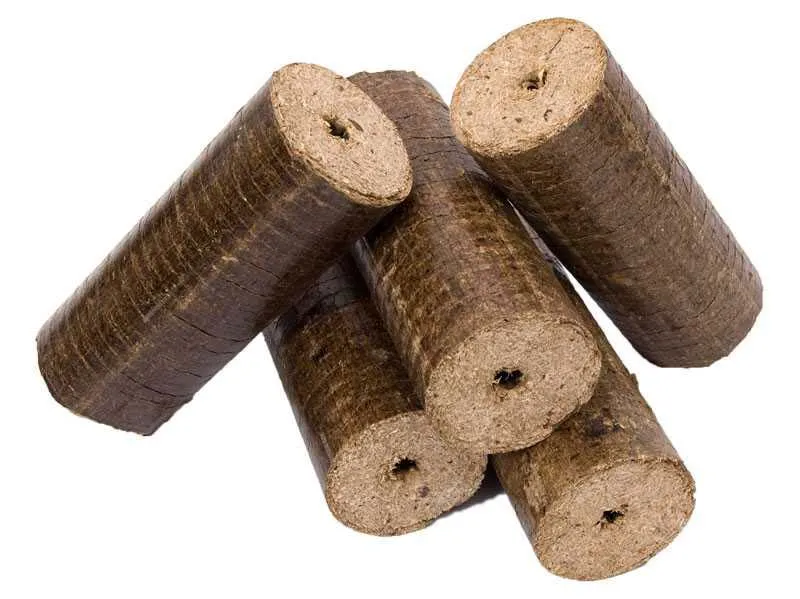
Wood briquettes vs firewood vs pellets cost per kWh
Why does moisture matter so much?
Water in the fuel has to evaporate before the wood burns, and that energy leaves up the chimney as steam. Forest Research states that a fresh green log has only around half the energy of a well-seasoned one. The FAO gives a similar picture: air-dried wood at 12 to 20 per cent moisture yields about 13 to 16 MJ/kg, while wood at around 50 per cent yields much less.
Pellets and briquettes are dried and pressed before sale, so their moisture is low and stable. Firewood depends on how long it was seasoned and how it was stored. If you want to check pellet moisture in detail, see our guide to wood pellet moisture content.
What efficiency should you assume?
Efficiency is how much of the fuel energy ends up as useful heat in your home. It depends on the appliance more than the fuel, so use the figure from your stove or boiler data sheet when you have it. As planning ranges, modern pellet boilers and stoves are often rated at roughly 85 to 93 per cent, and log stoves at roughly 70 to 80 per cent. Our guide on wood pellets vs firewood uses similar ranges.
In the example below we use 88 per cent for pellets, 78 per cent for briquettes in a closed log stove and 75 per cent for logs in the same kind of stove. These are assumptions for illustration, not measured values for your appliance.
What happens with wet firewood?
Take the same logs at the same price, but with about 50 per cent moisture and an energy value of about 2.0 kWh/kg. At 75 percent efficiency, that gives 1.5 useful kWh per kg, so the cost rises to about 0.256 / 1.5 = 0.17 EUR per kWh. That is more than double the seasoned figure, before counting the extra smoke and chimney deposits.
This is why the kiln-dried or well-seasoned label matters more than the headline price. A cheap load of damp logs is usually the most expensive fuel in this comparison. Our cost comparison of wood and pellets covers more heating scenarios.
What else changes the real cost?
The formula covers fuel and efficiency, but a few other items can move the result by several percent.
- Delivery: transport is often a fixed charge per load, so a full pallet or a larger log delivery lowers the cost per kg. Always compare delivered prices.
- Bag size and handling: small bags cost more per tonne than bulk loads. Our article on bulk vs bagged wood pellets shows how much the packaging can matter.
- Storage losses: pellets and briquettes that take up damp air lose value, and logs stored uncovered gain moisture. Keep every fuel dry and off the ground.
- Seasonal price swings: prices for all three fuels usually move with demand, and buying outside the main heating season can lower the quote.
If you buy from different suppliers, ask each one for the declared moisture and the weight per pack or per stacked cubic metre. Those two numbers decide whether a low price is actually low.
How do you run your own comparison?
- Write down the delivered price, including transport, for each fuel.
- Convert it to price per kg using the actual weight.
- Find the kWh/kg value on the data sheet or use the ranges above.
- Take the efficiency from your appliance manual.
- Apply the formula and compare cents per kWh.
Then add non-price factors: storage, ash removal, time spent loading and how your appliance handles each fuel. Briquettes and logs suit a manual stove, while pellets suit automatic feed systems.
Which fuel is cheapest per kWh?
It depends on local prices and your appliance. In our example, the three fuels differ by only a few per cent, so run the formula with current quotes.
Do briquettes really give more heat than firewood?
Per kilogram, yes, because they are drier. Per cubic metre of storage, the gap is larger, since briquettes are denser than stacked logs.
How do I convert MJ/kg to kWh/kg?
Divide by 3.6. For example, 17 MJ/kg is about 4.7 kWh/kg.
Should I include ash and cleaning costs?
It is reasonable to add them as a time cost. Pellets and briquettes usually leave little ash, while logs leave more.
Is the efficiency the same for every stove?
No. It varies by appliance, installation, and how you operate it. Use the rated figure from your manual where possible.
See our ENplus A1 pellets, RUF briquettes and beech firewood to put your own prices into the formula. We deliver across Europe.
Are wood briquettes cheaper than logs?
Yes, per kWh of heat. Briquettes cost more per kilo, but they release about 4.8 kWh per kg against roughly 4.1 kWh per kg for seasoned logs, so the usable heat per pound spent is higher with briquettes.
Is it cheaper to burn wood or pellets in 2026?
Pellets usually win for whole house heating because pellet boilers reach up to 90 percent efficiency, while log stoves convert far less of the fuel. Our detailed answer sits in is it cheaper to burn wood or pellets.
How many kWh does one kilogram of wood briquettes produce?
A quality briquette produces 4.7 to 4.9 kWh per kg at 6 to 10 percent moisture. Cheap, damp briquettes can fall below 4.0 kWh per kg, which is why certification matters.
How much firewood equals one tonne of wood pellets?
One tonne of pellets holds about 4,600 to 4,800 kWh. To match it with seasoned logs at 4.1 kWh per kg you need roughly 1.1 to 1.2 tonnes of wood, which occupies three times the storage space.
Which is better for a stove, briquettes or firewood?
Briquettes suit long, controlled burns, while logs give the traditional flame many owners want. Most of our stove customers run both, logs for the evening and briquettes to hold the bed overnight.
That is our answer to wood briquettes vs firewood vs pellets cost per kWh: buy certified fuel, buy in bulk, and match the fuel to the appliance. Ready to lock in your winter fuel? Send us your delivery point and volume through contact us, browse the Shop, or read more answers in our FAQ. We quote every load with the cost per kWh stated plainly, because informed buyers buy better fuel.
wood briquettes vs firewood vs pellets cost per kWh, cost per kWh of wood pellets, wood briquettes price per kWh, firewood cost per kWh UK, cheapest wood fuel in Europe
References
-
- Duffield Timber. Biomass wood pellets and briquettes guide. https://duffieldtimber.com/the-workbench/wood-fuels/biomass-wood-fuels-guide
- Pellets-Wood.com. 2025 wood pellet market in Germany, price trends. https://pellets-wood.com/news-german-pellet-market-2025-price-trends-and-future-prospects-13.html
- Fuse Energy. Is wood burning cheaper for heating, Ofgem price cap data. https://www.fuseenergy.com/blog/wood-cheaper
- Charlton and Jenrick. Cost of firewood, UK price per kWh analysis. https://www.charltonandjenrick.co.uk/news/2024/02/cost-of-firewood/
- Research and Markets. Europe wood pellet market size and forecast, Stove Industry Alliance data. https://www.researchandmarkets.com/report/europe-wood-fuel-market
- Wood Fuel Co-operative. Fuel comparison guide for logs, briquettes and pellets. https://www.woodfuel.coop/wood-fuel-guides/fuel-comparison-charts/
- Forest Research, Biomass Energy Centre: Wood as fuel
- FAO: Parameters, units and conversion factors
- ENplus Handbook Part 3, pellet quality requirements (copy hosted by a certified company)
Last updated: October 2026