

 Čeština
 Deutsch
 Română
 Polski
 Italiano
 Español
 Nederlands
 Magyar
 Slovenčina
 Slovenščina
 Hrvatski
Shisha charcoal vs hookah coal: which fuel wins on flavour and burn time?
Shisha charcoal vs hookah coal explained by fuel experts: burn time, heat control, CO levels and bulk prices for natural coconut charcoal across Europe. Shisha charcoal vs hookah coal is mostly a question of naming, because both terms describe the same product: the coal that heats the tobacco in a hookah bowl. The choice that actually matters is between natural coconut charcoal and quick-light coals. Natural charcoal burns longer with little ash and a neutral taste, while quick-light coals ignite in seconds but contain additives.
Shisha charcoal vs hookah coal, natural coconut charcoal for hookah, buy shisha charcoal online. UK, quick-light hookah coals, bulk hookah charcoal, Europe
Order natural shisha charcoal in bulk
We supply 100% natural coconut shisha charcoal in 25 mm cubes, flats and finger shapes, pressed from carbonised coconut shells with nothing but a natural starch binder. No sulphur, no nitrates, no chemical aftertaste. Our charcoal lights on a coil burner in 8 to 10 minutes, holds a steady heat plateau for 60 to 90 minutes and leaves only a trace of ash, so the flavour of your shisha tobacco stays exactly as the blender intended.
Retailers and lounges order by the pallet or by the truck; private customers can order by the box. We deliver to the UK, Germany, Austria, the Netherlands, Poland, Italy, Romania, Spain and Czechia, with volume pricing that improves the larger your order gets. Request a quote through our contact page, and we will confirm current stock and freight within one working day.
Shisha charcoal vs hookah coal: which fuel wins on flavour and burn time?
The debate around shisha charcoal vs hookah coal puzzles many first-time buyers, and the honest answer is refreshingly boring: they are the same fuel. ‘Shisha’ is the word used across Europe and the Middle East, and ‘hookah’ across India and the UK. The comparison that matters is not the label on the box but the material inside it, natural coconut charcoal against quick-light coals. We supply both grades in bulk from most of Europe, so here is the comparison, fog-free.
How long does shisha charcoal burn?
Burn time depends on size, density and how you set up the bowl, so treat any figure as a rough guide. Natural coconut cubes of 25 to 26 mm commonly last about 45 to 90 minutes under a foil or heat management device. Larger 28 mm cubes and dense flats tend to sit at the upper end. Quick-light tablets are usually thinner and often fade within 20 to 40 minutes.
Some factors change the numbers considerably:
- Airflow: a draughty room or a heavy pull speeds up burning.
- Coal placement: coals sitting on top of the foil burn faster than coals shielded by a heat management device.
- Coal density: heavier pressed coals usually last longer than light, airy ones.
- Moisture: coals stored in a humid place light unevenly and burn shorter.
Which one gives better heat?
Natural coals deliver steady heat once fully lit. A properly ignited coconut coal holds a stable temperature for most of its life, which gives you a predictable session. Quick-light coals often start hot because the additive burns fiercely and then drop off sooner. The result can be harsh tobacco at the beginning and weak clouds at the end.
The temperature at the tobacco is lower than most people expect. Reference sources describe foil temperatures of roughly 450 degrees Celsius and tobacco around 130 degrees Celsius, as noted on the Wikipedia article on hookahs. Two or three coals on a medium bowl are usually enough. A fourth coal normally just burns the tobacco.
What is the difference between shisha charcoal and hookah coal?
Shisha charcoal and hookah coal are two names for the same fuel. ‘Shisha’ is the European and Arabic term, and ‘hookah’ is the Indian and British one.
None. The words are regional synonyms, nothing else. A German shop lists the product as Shisha Kohle online Deutschland kaufen, a Polish retailer calls it shishy, and a Romanian lounge orders carbune pentru nargilea. Same cubes, same burn curve, same ash. When people genuinely mean something different, they are talking about the material: natural versus quick-light. That is where the shisha charcoal vs hookah coal question turns into a fuel-quality question.
Which types of shisha charcoal can you buy in Europe?
European shops stock natural coconut cubes, flats, bamboo and wood coals, plus quick-light discs treated with chemical accelerants.
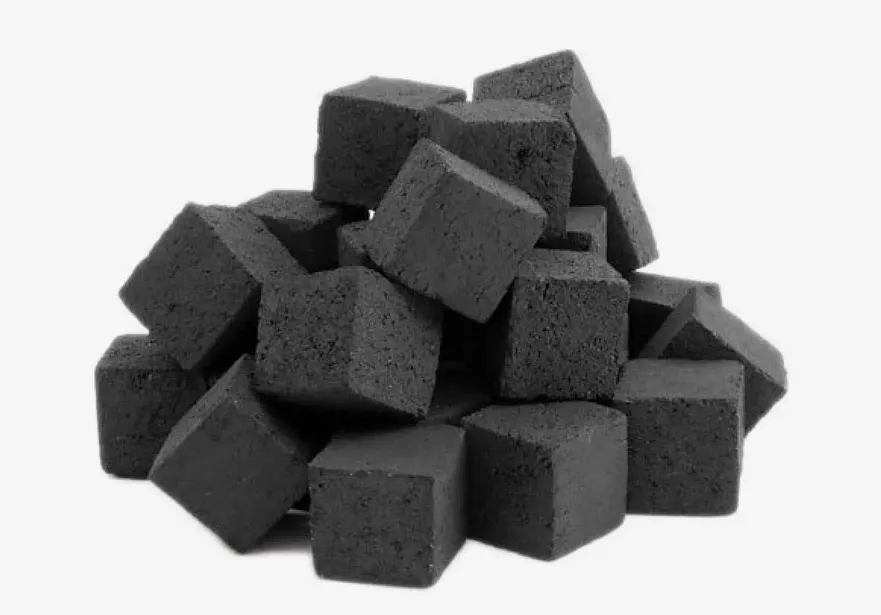
Natural coconut charcoal is the industry standard. Manufacturers carbonise crushed coconut shells, press them with a natural starch binder into dense cubes or flats, and skip every additive. The result is odourless, tasteless and dense, which is why serious smokers treat it as the benchmark. Our buy shisha charcoal online UK listing shows the format most European lounges order most often: 25 mm cubes.
Quick-light coals are discs coated in sulphur or nitrate accelerants so they catch fire from a plain lighter. The convenience is real, and the price of that convenience shows up in your bowl.
Wood and bamboo charcoal, from lemonwood, orangewood or bamboo, is the traditional option. It burns slightly cooler than coconut, adds a faint woody note and still has loyal followings across the Balkans and the Middle East.
Why material quality decides your session
A premium bowl of shisha ruined by two cents of chemical-laden quick-light is still a ruined session. Coconut shell charcoal, dense cubes with high fixed carbon, low ash and zero accelerants, is the standard, and it is the fuel we ship in the largest volumes through our charcoal category.
Why do quick-light hookah coals change flavour and raise carbon monoxide?
Quick-light discs contain sulphur and nitrate accelerants that taint flavour and produce far more carbon monoxide than natural charcoal, lab tests show.
A peer-reviewed study indexed on PubMed measured carbon monoxide output from natural and quick-light charcoals under controlled conditions. The quick-light briquettes produced substantially more CO, and the authors wrote plainly:
“The high levels of CO produced when using quick-light charcoals may be contributing to the increase in reported hospital admissions for severe CO poisoning.”
Clinical case reports back this up. A patient treated after lighting coals at a hookah bar showed a carboxyhemoglobin level of 33.8 per cent, higher than any previously documented hookah exposure at the time. Research published in Circulation adds that charcoal combustion loads hookah smoke with large amounts of carbon monoxide alongside the tobacco toxicants. Manufacturers rarely disclose which accelerants they use, and that silence alone is a reason to prefer natural fuel. Flavour tells the same story: any chemical taste means the accelerant coating never fully burnt off.
How long does each hookah coal burn, and how hot does it get?
Natural coconut cubes burn for 60 to 90 minutes, and premium 25 mm cubes can pass 120 minutes, roughly double the life of a quick-light disc.
The same lab comparison found natural charcoal burnt significantly hotter at the bowl, around 292 degrees Celsius on average against 247 for quick-light, while holding a more stable plateau. Here is how the main fuel types compare.
| Fuel type | Ignition | Burn time | Heat behaviour | Ash | Flavour | Best for |
|---|---|---|---|---|---|---|
| Coconut cubes (25 mm) | 8 to 10 min on a coil burner | 60 to 90 min, premium up to 120 | Stable plateau, predictable | Very low | Neutral | Lounges, long sessions, heat management devices |
| Coconut flats | 6 to 8 min on a coil burner | 45 to 60 min | Gentle, even | Very low | Neutral | Foil setups, smaller bowls |
| Quick-light discs | Seconds with a lighter | 40 to 60 min | Spikes, then declines unevenly | Moderate | Chemical note possible | Travel, emergencies, no burner available |
| Wood or bamboo coals | 8 to 10 min on a coil burner | 45 to 70 min | Slightly cooler, steady | Low | Faint woody aroma | Traditional smokers, Balkan and Middle Eastern styles |
How many cubes should you use per session?
For a standard foil bowl, two to three 25 mm coconut cubes; for a heat management device, two is typical. Start with fewer, because you can always add heat, but a scorched bowl cannot be unscorched. Coil burner lighting takes about ten minutes, which is why lounges keep several burners running.
Which shisha charcoal is best for European lounges and home sessions?
Natural coconut cubes are the best shisha charcoal for European lounges: clean taste, stable heat and the lowest cost per minute of burn.
Coconut cubes last 1.5 to 3 times longer than quick-lights, so each session needs fewer coals, and each box yields more sessions. Smoke purity is the second argument: compressed coconut shell contains zero chemical accelerants, which keeps the shisha flavour pure and unpolluted. For lounges, that means fewer complaints; for home smokers, purer flavour. The same logic applies to barbecue fuel, as we covered in our lump charcoal vs briquettes guide: fuel choice sets the heat curve before anything else does.
Where can you buy shisha charcoal in bulk in the UK, Germany and across Europe?
Order bulk shisha charcoal by the tonne or pallet from woodbrezany, with truck delivery to the UK, Germany, Poland, Italy, Romania and Czechia.
We ship from Woodbrezany, near the Austrian border, which puts most EU destinations within two days of freight. Country shops and lounges can order shisha houtskool online in the Netherlands, shisha carboncino in Italy, carbón de cachimba in Spain or sisové uhli Czechia directly through the shop. Wholesale buyers ordering by the truck get the best price per kilo, and our team confirms current freight rates on the contact page. If you want to know who stands behind the coal, read about woodbrezany or check the frequently asked questions.
Key takeaways
- Shisha charcoal and hookah coal are synonyms. The real choice is natural versus quick-light fuel.
- Natural coconut charcoal burns longer, 60 to 90 minutes per session, with stable heat and minimal ash.
- Quick-light coals ignite in seconds but add a chemical taste and produce far more carbon monoxide.
- Two to three 25 mm cubes are enough for a standard bowl; more heat scorches the shisha.
- Bulk buyers in Europe can order by the pallet or truck from Woodbrezany with EU-wide delivery.
FAQ about shisha charcoal vs hookah coal
Is shisha charcoal the same as hookah coal?
Yes. ‘Shisha charcoal’ and ‘hookah coal’ are two regional names for the same product. ‘Shisha’ is the European and Arabic term, ‘hookah’ is the Indian and English one, and the material inside the box is identical.
Can you use barbecue charcoal in a hookah?
No. BBQ charcoal often contains lighter-fluid additives, burns too fast and changes the taste of the shisha. Hookah charcoal is made to give steady heat without interfering with flavour.
How do you light natural hookah charcoal without chemicals?
Use an electric coil burner and rotate the cubes every two to three minutes until each side glows red, which takes 8 to 10 minutes. A kitchen stove with an exposed coil also works.
How long does hookah charcoal last in storage?
Stored dry and sealed, natural coconut charcoal keeps for 2 to 5 years. Damp storage is the enemy, because moisture makes cubes crack and ignites unevenly.
How much carbon monoxide does hookah charcoal produce?
Every burning coal produces some carbon monoxide. Controlled tests show quick-light coals produce substantially more CO than natural charcoal, which is why we recommend natural cubes and good ventilation.
Which countries does Woodbrezany ship bulk shisha charcoal to?
We deliver across Europe, including the UK, Germany, Austria, the Netherlands, Poland, Italy, Romania, Spain and Czechia, by pallet or full truck. Ask us for a freight quote through the contact page.
Is there a difference between shisha charcoal and hookah coal?
No. “Shisha charcoal”, “hookah coal”, “hookah charcoal” and “shisha coals” all refer to small pieces of charcoal made for heating flavoured tobacco in a water pipe. Regional habits decide which word you see. Shisha is common in Europe and the Middle East, hookah in North America, and shops often use both in the same listing.
The real differences are in the raw material and in how the coal lights. That gives you two main families: natural coals, usually pressed from carbonised coconut shell, and quick-light coals, which are charcoal tablets treated with a chemical ignition aid. Everything else in this guide compares those two.
What are natural coals and what are quick-light coals?
Natural coconut charcoal
Natural coals are made by carbonising coconut shells, grinding the charcoal and pressing it into cubes, flats or hexagons, usually with a small amount of binder. They have no ignition chemicals. You light them with an electric coil stove, a gas flame or a charcoal burner, and they need a few minutes to reach an even glow. Our natural coconut shisha charcoal belongs to this group.
Quick-light coals
Quick-light coals are tablets, often made from wood charcoal, that carry an ignition aid on the surface or inside. Hold one over a flame and it sparks, then glows within roughly 30 to 60 seconds. They are cheap and convenient, but you must let the sparking stop and the coal burn through before you use it, otherwise the additive can reach your tobacco.
How much ash do they leave?
Ash matters because it insulates the coal from the air and from the foil. Heavy ash cools the coal and hides how hot it still is. Natural coconut coals usually leave a small amount of fine, pale ash. Quick-light tablets, especially cheap ones, tend to leave more ash, and some crumble when you tap them.
Low ash also keeps your bowl, foil and tray cleaner. If you run a lounge or smoke several times a week, fewer ashes means less cleaning and less waste between sessions.
Which one tastes better?
Taste is where the difference is easiest to notice. Natural coconut charcoal burns without a strong smell, so the tobacco flavour stays at the front. Quick-light coals can add a sulphur or chemical note, mainly while the coal is still sparking or in the first minutes after you place it on the bowl.
You can reduce that effect by lighting quick-light coals well away from the pipe and letting them turn fully grey on the edges before use. Many experienced smokers still avoid them for delicate or fruity tobaccos, because even a faint off-note is clear in those blends.
Which is safer?
Neither type is safe in the sense of being harmless. Burning any charcoal produces carbon monoxide, and the US Centers for Disease Control and Prevention states that burning charcoal indoors gives off carbon monoxide, whatever its colour. The CDC also notes that charcoal used to heat hookah tobacco can produce high levels of carbon monoxide, metals and cancer-causing chemicals.
So the safety question is about how much extra you add. Natural coals have no ignition chemicals, which removes one source of unwanted fumes. Quick-light coals add a chemical residue, which is why they need to be fully lit and burnt out before use. In both cases, follow these rules:
- Smoke in a room with good ventilation, and never in a closed small space.
- Install a carbon monoxide alarm where you use the hookah.
- Never leave burning coals unattended, and never move glowing coals by hand.
- Place the coal burner or stove on a stable, heat-resistant surface away from fabric and paper.
- Let used coals cool fully before you throw them away, and keep water nearby.
Hookah smoking carries health risks of its own, regardless of the coal. The tobacco smoke is not made safe by choosing a cleaner coal.
Natural vs quick-light coals compared
| Feature | Natural coconut coals | Quick-light coals |
|---|---|---|
| Lighting time | About 5 to 10 minutes on a stove or burner | About 30 to 60 seconds over a flame |
| Typical burn time | About 45 to 90 minutes, depending on size | About 20 to 40 minutes |
| Heat pattern | Steady and even | Strong start, faster drop |
| Ash | Low, fine and pale | Usually higher, can crumble |
| Taste | Neutral | Possible chemical note if not fully lit |
| Extra equipment | Stove or burner needed | Only a lighter |
| Price per session | Often higher per coal, lower per hour | Lower per coal |
The figures are typical ranges, not guarantees. Brands, sizes and your setup change the result, so test a new coal before you serve it to guests.
How to light and use shisha charcoal properly
- Place the coals on an electric coil stove or a dedicated burner and heat for about 5 to 10 minutes, turning once.
- Wait until the coal is glowing orange and covered with a thin layer of grey ash on the surface.
- Fan off loose ash, then place the coals on the foil or heat management device.
- Start with two coals on a standard bowl, and add a third only if the heat is clearly too low.
- Rotate or swap the coals after about 30 to 40 minutes to keep the heat even.
Lighting natural coals with a lighter or a gas torch alone often gives a coal that glows on the outside but stays cold inside. A burner or stove lights the whole piece, and that gives the longer, even burn.
How to choose the right coal
Pick natural coconut charcoal if you smoke for the flavour, host long sessions or run a lounge. The coal costs more per piece, but the longer burn time and low ash often make it cheaper per hour. Pick quick-light only for occasional short sessions where speed matters more than taste, and use them with care.
Check the pack for the size and shape that fits your bowl, a clear statement of the raw material and a dry, sealed bag. If the coals feel damp or crumbly, they will light unevenly. Store them in a closed container in a dry room. If you are interested in how pressed charcoal differs from other compressed fuels, read our guide to wood briquettes.
Our briquetted charcoal is a barbecue fuel, not a replacement for shisha coals. It is a different product with larger pieces and different burning behaviour, so do not use it in a hookah bowl.
Is hookah coal the same as barbecue charcoal?
No. Hookah coals are small, uniform pieces made for low, steady heat on top of a bowl. Barbecue charcoal comes in larger lumps or briquettes and burns hotter and with more ash. Using barbecue charcoal in a hookah is not recommended.
Can I light natural shisha charcoal with a lighter?
You can start it that way, but the result is usually uneven. A lighter heats the surface only, so the core stays dark. An electric stove or a charcoal burner lights the full coal and gives a more reliable burn.
Why does my coal taste bad?
The most common causes are a coal that is not fully lit, a quick-light coal that still carries its ignition aid, or a damp coal. Let the coal glow evenly with grey ash before use, and store coals in a dry, closed container.
Can I reuse a partly burnt shisha coal?
You can, if it still looks solid, but it will light faster and burn shorter the second time. Let it cool completely first. Do not reuse coals that crumble or smell odd.
How many coals do I need per session?
Two to three coals are enough for most standard bowls. A session of one to two hours may need a fresh coal or a swap halfway through, depending on the coal size and your bowl.
Where to buy shisha charcoal
See our natural shisha charcoal for home use or lounges, and read our guide to mixing charcoal and wood pellets if you also cook with solid fuels. We deliver across Europe.
References
- PubMed, Research report: charcoal type used for hookah smoking influences CO production, pubmed.ncbi.nlm.nih.gov/26403022
- NIH/PMC, Carbon monoxide toxicity after lighting coals at a hookah bar, pmc.ncbi.nlm.nih.gov/articles/PMC4141928
- Circulation (American Heart Association), High carbon monoxide levels from charcoal combustion in hookah smoking, ahajournals.org
- Kaloud, Coconut vs quick-light hookah charcoal: burn time and heat stability, kaloud.com
- Fumari, Hookah coal types: a beginner’s buying guide, fumari.com
- GoChicha, Shisha charcoal guide: burn times by fuel type, gochicha.com
- Hookah Vault, Coconut coals vs quick-light coals comparison, hookahvault.com
Last updated: October 2026