
 Čeština
 Deutsch
 Română
 Polski
 Italiano
 Español
 Nederlands
 Magyar
 Slovenčina
 Slovenščina
 Hrvatski
Types of wood briquettes: RUF, Nestro, Pini Kay, and more
3 types of wood briquettes primarily differ in their pressed shape, with different burn times and heat output. Learn which type suits your stove and order in bulk across Europe.
- Wood briquettes come in five main types: RUF, Nestro, Pini Kay, bark, and peat-wood hybrid. Each has a distinct shape, density, burn time, and application.
- RUF is the most affordable, easiest to light, and best for daily use. Moisture: 6 to 8%. Burn time: 4 to 5 hours.
- Nestro offers the best overnight performance, with the highest density of the pure-sawdust types and a burn time of 5 to 6 hours.
- Pini Kay delivers the hottest flame and highest density, reaching up to 17.4 MJ/kg. Best for open fireplaces and high-performance stoves.
- Bark briquettes burn cooler and slower, suiting supplementary or long daytime use.
- Peat-wood hybrid briquettes combine the renewable character of wood with peat’s high calorific value and long burn time.
- Europe accounts for over 37% of global biomass briquette demand, and buying by the tonne or truckload reduces cost per kWh significantly.
- We supply all types in bulk across Europe. Browse our full product range in our shop.
Buy wood briquettes in bulk across Europe.
Wood briquettes are a fuel source made from dried, compacted wood. They are made from wood waste or byproducts and machine-compressed into a log or block shape, generally without added ingredients, though they can include materials like peat.
At Wood-Břežany S.R.O., we supply premium wood briquettes by the tonne or truckload to residential buyers, commercial heating operators, and wholesale distributors across Europe. Whether you need RUF briquettes for a daily-use boiler, Pini Kay for an open fireplace, or Nestro for overnight heating, our range covers every application. Our briquettes carry a moisture content of 6 to 10%, deliver up to 4.9 kWh/kg, and produce minimal ash, making them a reliable, cost-effective alternative to firewood.
We serve customers in the Czech Republic, Germany, Austria, Switzerland, Poland, Romania, Italy, the Netherlands, Slovakia, Slovenia, Croatia, Hungary, Spain, and beyond. Orders are available on pallets (960 kg standard), by the tonne, or by full truck. All products ship directly from our depot, with competitive pricing and consistent quality on every consignment.
Buy wood briquettes online and get a quote today, or browse our full range in the shop.
Types of wood briquettes: a complete buyer’s guide for Europe
Wood briquettes are not all the same. If you have ever ordered a pallet and found it burns through faster than expected or struggles to fit your stove chamber, the shape and raw material almost certainly made the difference. Wood briquettes are produced in several common pressed shapes that differ in burning behaviour and handling. Knowing which type to buy before you place a bulk order saves money and avoids wasted fuel.
We supply wood briquettes by the tonne and by the truckload across Europe, and we hear the same questions every heating season: What is the difference between RUF and Nestro? Can bark briquettes replace sawdust briquettes? Which type is best for overnight use? This guide answers all of them, with the data to back it up.
What exactly is a wood briquette?
Wood briquettes are compressed blocks of dried wood waste, typically sawdust, shavings, or bark, pressed without chemical binders into a dense, uniform fuel block.
Wood briquettes are a fuel source made from dried, compacted wood. They are made from wood waste or byproducts and machine-compressed into a log or block shape, generally without added ingredients. The compression process itself, reaching pressures between 500 and 1,500 bar depending on the machine type, activates natural lignin in the wood, which acts as a binder and holds the block together without any chemical additives.
The low moisture content of about 10% leads to an energy content of around 5.0 kWh per kg, depending on the type of wood and the compression. Compare that to typical air-dried firewood, which carries moisture levels of 18 to 25% and delivers closer to 3.0 to 3.5 kWh/kg, and the efficiency advantage becomes clear.
Wood briquettes transfer heat much more efficiently than ordinary firewood: during combustion, briquettes release around 4,500 kcal/kg, while logs produce no more than 3,000 kcal/kg.
What are the main types of wood briquettes?
There are five main types of wood briquettes: RUF, Nestro, Pini Kay, bark briquettes, and peat-wood briquettes. Each differs by shape, density, raw material, and burn behaviour.
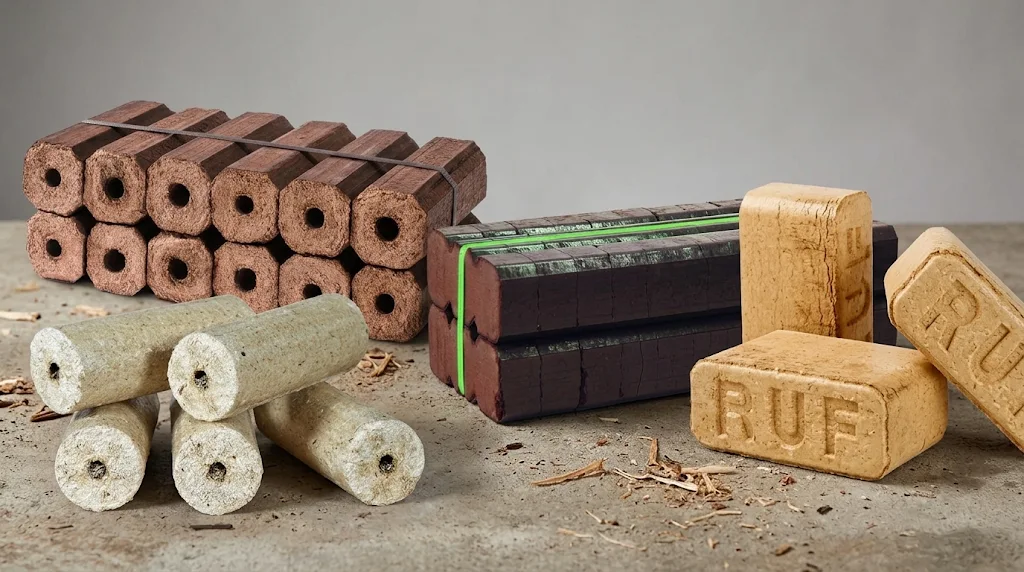
The difference between RUF, Nestro, and Pini Kay comes down to shape, density, and how each block burns. RUF is a small brick, Nestro is a solid cylinder, and Pini Kay is a dense block with a central hole. Beyond those three, bark briquettes and peat-wood hybrid briquettes serve specific use cases worth understanding before you buy.
Buy RUF briquettes: the most popular shape in Europe
RUF briquettes are small rectangular blocks, typically 150 x 90 x 60 mm, pressed from pure sawdust under hydraulic pressure. They light easily and suit daily heating in stoves and boilers.
RUF briquettes are made of sawdust and look like a brick. The hydraulic pressing method gives them a bulk density of around 0.75 to 0.80 g/cm³, lower than Nestro or Pini Kay, which means they light more quickly and produce a visible flame sooner. With a moisture content of 6 to 8% and ash content under 0.7%, RUF briquettes provide consistent warmth for daily heating.
Their standard pallet format, 960 kg per pallet (96 packs of 10 kg each), makes them straightforward to handle and store in a garage or utility room. 1 tonne of briquettes is equal to approximately 5 cubic metres of firewood or 480 to 500 cubic metres of natural gas.
RUF briquettes deliver a burn time of around 4 to 5 hours and a calorific value of approximately 4,400 kcal/kg, making them well suited to automated boilers and fireplaces.
Best for: Daily-use wood-burning stoves, automated biomass boilers, and buyers who prioritise ease of loading and stacking.
Buy RUF wood briquettes online directly from our warehouse, or read our detailed RUF briquettes guide for production and storage advice.
Best Nestro briquettes for overnight heating
Nestro briquettes are solid cylinders made from 100% pure sawdust, with a density of around 1.0 to 1.15 g/cm³. They burn longer than RUF and are the preferred choice for overnight heating.
Nestro briquettes are cylindrical heat logs made from 100% pure sawdust with no bark, binders, or additives. The cylindrical shape and higher compression density result in a slower, steadier combustion profile compared to the brick-shaped RUF. Nestro briquettes are round and have similar burning behaviour to RUF briquettes but are considered slightly more versatile.
Nestro briquettes are ideal for quickly warming a room, delivering a burn time of 5 to 6 hours and a calorific value of approximately 4,700 kcal/kg.
For customers who stoke their stove before bed and need heat through to morning, Nestro is usually the right call. For overnight heating, most customers use 2 to 3 Nestle logs depending on the size of the stove.
Best for: Overnight heating, log burners, and stoves that need a long, even fuel load.
Buy Nestro wood briquettes online and compare them directly with RUF and Pini Kay in our dedicated comparison post.
Where to buy Pini Kay briquettes: maximum heat output
Pini Kay briquettes are dense, octagonal or hexagonal blocks with a central hole. They deliver the highest heat output of the three main types, with burn times of 4 to 8 hours depending on the stove.
Pini Kay is the densest type, with a central hole for airflow and usually the hottest burn. The screw press and heat-treatment production method compresses the wood to a density of 1.1 to 1.4 g/cm³, the highest of the three major formats. The central hole serves a practical purpose: it channels air into the core of the briquette, sustaining combustion from the inside out and extending burn time while keeping the flame temperature high.
Pini Kay briquettes typically burn for 4 to 6 hours, depending on your stove type and air supply settings. In a well-sealed, high-efficiency stove, that figure can extend further. Pini Kay is the most expensive to produce because of the screw press and heat treatment.
The heating value of Pini Kay briquettes reaches approximately 17.4 MJ/kg, the highest measured across common briquette types in standard testing conditions.
Best for: Open fireplaces, high-performance stoves, long evening burns, and buyers who prioritise heat intensity over price per unit.
Buy Pini Kay briquettes online or learn how RUF briquettes are made if you are deciding between production methods.
What are bark briquettes, and are they worth buying?
Bark briquettes are pressed from wood bark rather than sawdust. They burn cooler and slower than sawdust briquettes, producing a consistent, long-lasting heat with slightly higher ash content.
Bark briquettes, created using bark chippings, tend to give a lower heat output but will tend to last a lot longer than sawdust briquettes. They give out a consistent, slow burn with a steady heat supply. This makes them a sensible complement to sawdust briquettes: start the fire with RUF or Nestro, then add bark briquettes to sustain heat with less attention.
Wood briquettes’ ash and sulphur content vary. Some pure wood briquettes with the bark removed can have as low as a 0.3% ash content, while briquettes with added bark can have higher ash content. Bark briquettes typically sit at around 1 to 1.5% ash, which is still substantially lower than coal or low-grade firewood.
We supply RUF bark briquettes, a rectangular-format bark product well suited to buyers who want slower, budget-conscious heating without the heat intensity of a Pini Kay. Buy RUF bark briquettes online from our shop.
Best for: Cost-conscious buyers, long daytime burns, supplementary fuel for stoves already running on sawdust briquettes.
How do peat-wood briquettes differ from pure wood briquettes?
Peat-wood briquettes combine compressed peat with wood material to produce a denser block with a longer burn time and higher calorific value than pure wood. They suit stoves designed for multi-fuel use.
Peat briquettes are a solid fuel produced by compressing dried peat without chemical additives. Under high pressure, peat forms dense briquettes that are easy to store, transport, and use.
Peat briquettes carry a calorific value of approximately 3,800 to 4,500 kcal/kg with a low moisture content of 10 to 15%, ensuring efficient combustion and a long, slow burn. The blend of peat and wood in hybrid briquettes narrows the gap between the renewable credentials of wood and the sustained heat output associated with peat.
Peat briquettes offer a slow, efficient burn, providing even heat distribution. For buyers in colder climates or with large properties requiring sustained heat through the night, peat-wood hybrid briquettes are worth considering alongside pure sawdust types.
Buy peat wood briquettes online from our European supply depot.
Comparison table: all types of wood briquettes at a glance
The following table summarises the main performance differences between the five briquette types based on available technical data.
| Type | Shape | Density (g/cm³) | Moisture content | Calorific value | Burn time | Ash content | Best application |
|---|---|---|---|---|---|---|---|
| RUF | Rectangular brick | 0.75 to 0.80 | 6 to 8% | approx. 4,400 kcal/kg (4.8 kWh/kg) | 4 to 5 hours | under 0.7% | Daily stove heating, automated boilers |
| Nestro | Solid cylinder | 1.0 to 1.15 | 5 to 7% | approx. 4,700 kcal/kg (4.9 kWh/kg) | 5 to 6 hours | 0.3 to 0.5% | Overnight heating, log burners |
| Pini Kay | Octagonal, central hole | 1.1 to 1.4 | 6 to 8% | approx. 4,650 kcal/kg (17.4 MJ/kg) | 4 to 8 hours | under 0.8% | Open fireplaces, high-performance stoves |
| Bark (RUF format) | Rectangular brick | 0.70 to 0.85 | 8 to 12% | approx. 4,200 kcal/kg | 5 to 7 hours | 1.0 to 1.5% | Long slow burns, supplementary fuel |
| Peat-wood hybrid | Rectangular or oval | 0.90 to 1.10 | 10 to 15% | 3,800 to 4,500 kcal/kg | 6 to 10 hours | 1.0 to 2.5% | Multi-fuel stoves, overnight heat |
Why European buyers are ordering wood briquettes in bulk in 2026
The growth of the biomass briquette market reflects a straightforward calculation: briquettes deliver more heat per unit of storage space and weight than firewood, with predictable quality and lower handling costs for large properties.
The global biomass briquette fuel market size was valued at USD 1,052.31 million in 2025 and is projected to grow to USD 1,130.60 million in 2026, reaching USD 2,007.42 million by 2034 at a CAGR of 7.44%.
Europe dominated the biomass briquette fuel market with a market share of 37.19% in 2025. That dominance reflects established heating infrastructure, strong renewable energy policy, and a supplier network capable of consistent bulk delivery.
Wood biomass briquettes are projected to hold 38.9% of the market share in 2026, due to their superior energy density and ease of processing.
By raw material, sawdust biomass briquettes led the market with a 34.05% share in 2025, confirming that the RUF and Nestro formats dominate commercial demand.
For wholesale buyers, distributors, and commercial heating operators, ordering by the truckload rather than by the pallet reduces cost per tonne substantially. We supply full truck deliveries of wood briquettes across Europe. Read our guide on how to order biomass by the truckload for logistics and minimum order details.
Which wood briquette type burns the longest?
Nestro briquettes and peat-wood hybrid briquettes generally deliver the longest burn times, ranging from 5 to 10 hours depending on stove size and air supply. Pini Kay burns hottest but duration depends on airflow settings.
Nestro is a cylinder with a long, even burn that suits overnight use. Pini Kay is the densest type, with a central hole for airflow and usually the hottest burn. If burn duration is your primary requirement, Nestro or bark briquettes will serve you better than RUF on a cold night. If heat intensity matters most, Pini Kay delivers a hotter flame at the cost of faster consumption.
We cover this topic with our own field-tested data in how long do wood briquettes last, and we compare the full cost per kWh in our wood briquettes vs firewood vs pellets cost per kWh comparison.
How to choose the right type of wood briquette for your stove
Stove type, chamber size, and heating pattern all affect which briquette format performs best. Here is a practical decision framework:
- Small stove, quick daily heating: Choose RUF. Small blocks light quickly and are easy to load.
- Large stove or fireplace, maximum flame: Choose Pini Kay. For maximum heat and performance, Pini Kay briquettes are the first choice.
- Overnight heating: Choose Nestro. Nestro is ideal as a night briquette for overnight heating and log burners.
- Long slow daytime burn: Choose bark briquettes. They give out a consistent, slow burn with a steady heat supply.
- Multi-fuel stove, sustained heat: Choose peat-wood hybrid. The long burn time burns slower than firewood, providing steady heat output.
The simplest approach for most buyers is to combine types: RUF or Pini Kay for starting and peak-heat periods, Nestro or bark for sustained burns. Combining different briquette types, such as RUF and Pini Kay, optimises heating throughout the day.
For stove-specific advice, our how to light a wood stove guide covers firing techniques that apply equally to briquettes and firewood.
What is the difference between RUF and Nestro briquettes?
RUF is a rectangular brick pressed by hydraulic press; Nestro is a denser solid cylinder. Nestro burns longer; RUF lights faster. Both are made from pure sawdust without binders.
RUF is a small brick, Nestro a solid cylinder, and Pini Kay a dense block with a central hole. RUF suits daily loading into smaller stoves, while Nestro is preferred for overnight use in log burners and larger heating systems.
Which type of wood briquette has the highest heat output?
Pini Kay briquettes deliver the highest heat output among the standard three types, with a calorific value of up to 17.4 MJ/kg, due to their screw-press production and higher density.
Pini Kay usually burns hottest, Nestro is the longest, and RUF is the easiest to stack and light, though figures vary by maker and batch.
Are bark briquettes worse than sawdust briquettes?
Bark briquettes are not worse; they serve a different purpose. They burn slower with lower heat intensity, making them suitable for sustained, low-attention heating rather than peak-heat applications.
Bark briquettes tend to give a lower heat output but will last longer than sawdust briquettes, giving a consistent, slow burn with a steady heat supply.
Can I mix different types of wood briquettes in the same stove?
Yes. Mixing types is a common and practical approach. Many buyers use RUF to start, then add Nestro or Pini Kay for sustained heat. Different formats can be loaded together without compatibility issues in most stoves.
Combining different briquette types, such as RUF and Pini Kay, optimises heating throughout the day. Check your stove’s chamber dimensions before mixing very different formats, as Pini Kay’s length may not suit smaller fireboxes.
Where can I buy wood briquettes by the tonne in Europe?
Wood-Břežany S.R.O. supplies all major types of wood briquettes by the tonne and by the truckload across Europe, with delivery to Germany, Poland, Czech Republic, Romania, Italy, the Netherlands, and further.
We ship from our central European depot. Visit our buy wood briquettes online page, check the about us page for company details, or contact us directly with your volume requirements and delivery address.
What is the best wood briquette for a wood-burning stove in the UK or Germany?
For UK and German wood-burning stoves, RUF hardwood briquettes and Nestro briquettes are the most practical formats, meeting moisture requirements below 10% and offering reliable heat output for the typical stove chamber sizes used in those markets.
Hardwood Nestro XL RED and RUF Original RED, both with calorific values above 4.8 kWh/kg, are suited to continuous, even heating in standard stoves. For buyers in Germany, our holzbriketts in Deutschland kaufen page lists available formats and delivery options.
References
- Value Market Research, Biomass Briquette Fuel Market, 2026 edition: global market valued at USD 1,052.31 million in 2025. Value Market Research
- European Commission, November 2023: EU RED III requires solid biomass such as wood briquettes to deliver at least 70% GHG emission savings versus fossil fuels. European Commission RED III
- Wikipedia, Wood briquette: low moisture content of about 10% leads to an energy content of around 5.0 kWh per kg, depending on wood type and compression. Wikipedia: Wood briquette
- Bioglow, Briquettes and Heat Logs Comparison Guide: Pini Kay briquettes deliver approximately 17.4 MJ/kg heating value under standard test conditions. Bioglow Comparison Guide
- Coherent Market Insights, Biomass Briquette Market, 2026: wood biomass briquettes projected to hold 38.9% of global market share in 2026, due to superior energy density. Coherent Market Insights
- LandGrou, Peat Briquettes for Heating 2025: peat briquettes carry a calorific value of approximately 3,800 to 4,500 kcal/kg with 10 to 15% moisture content. LandGrou Peat Briquette Guide
- Heizfuxx, Wood Briquettes Compared, October 2026: there is no universally best wood briquette, but there is the right briquette for your own fireplace and heating style. Heizfuxx Wood Briquette Comparison
RUF briquettes for heating, Nestro heat logs, Pini Kay briquettes, bark briquettes vs sawdust briquettes, wood briquettes bulk supply Europe