
 Čeština
 Deutsch
 Română
 Polski
 Italiano
 Español
 Nederlands
 Magyar
 Slovenčina
 Slovenščina
 Hrvatski
Wood briquettes vs coal briquettes: comparing calorific value, uses and costs
Comparing wood briquettes vs coal briquettes reveals two fundamentally different fuels, each with its own strengths. Wood briquettes are made from compressed sawdust and wood shavings, while coal briquettes are produced from carbonised biomass or hard coal. At Wood-Břežany, we supply households and businesses throughout Europe with both options and understand their practical differences from our daily work. This article explains calorific value, ash content, applications and costs so you can make the right decision for your stove, fireplace or barbecue.
Buy wood briquettes and coal briquettes cheaply for heating and barbecuing
We deliver wood briquettes and coal briquettes in large quantities directly to your address in Germany, Austria and Switzerland. Our wood briquettes consist of compressed hardwood and softwood with a moisture content below 10 percent. The coal briquettes provide even embers for barbecues and fireplaces. Order by the pallet or truckload and benefit from fair wholesale prices. Buy wood briquettes online in Germany or buy charcoal briquettes online directly through our shop.
What is the difference between wood briquettes and coal briquettes?
Wood briquettes are made from compressed sawdust without binders, while coal briquettes are pressed into shape from carbonised biomass with starch as a binder.
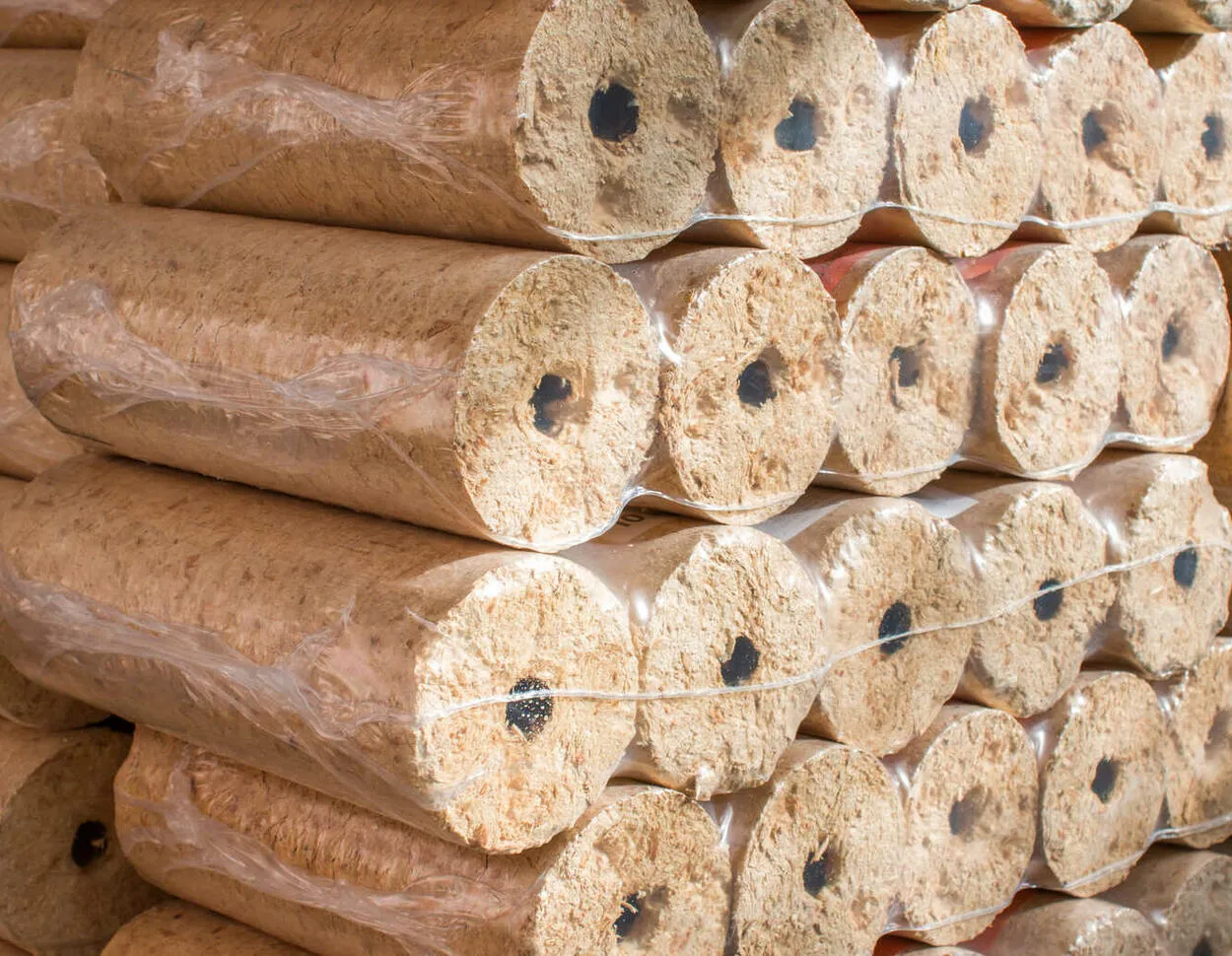
The main difference lies in the raw material and manufacturing process. Wood briquettes are pressed from dry sawdust, wood shavings or wood residues under high pressure. The wood’s natural lignin structure acts as a binder. The result is a clean fuel with a moisture content of approximately 6 to 10 percent. Learn more about production in our guide to wood briquettes and RUF briquettes.
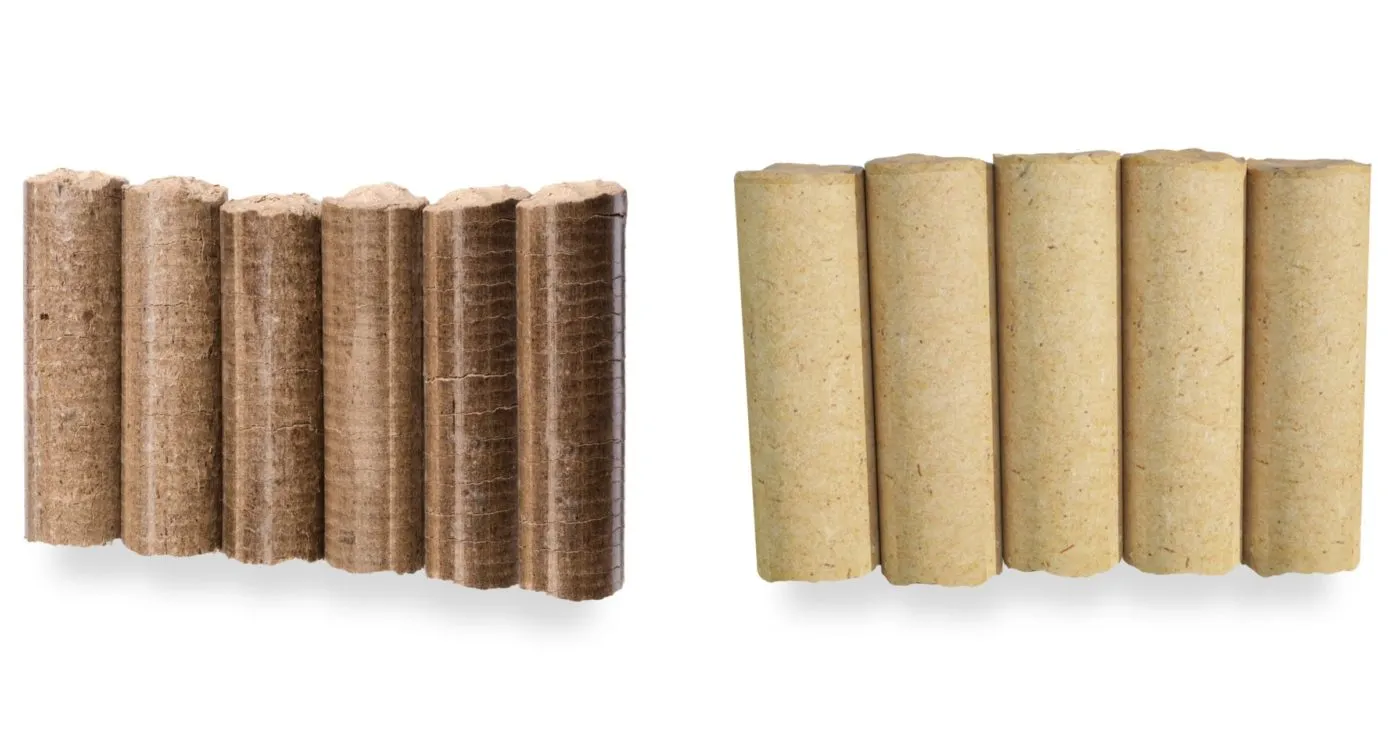
Coal briquettes, by contrast, are made by carbonising wood, coconut shells or hard coal at high temperatures without oxygen. The carbonised material is then pressed into shape with a binder, usually potato or corn starch. This process fundamentally changes the chemical composition and produces slower, more even combustion.
“The choice between wood and coal depends less on price than on the intended use. For heating, choose wood briquettes. For barbecuing, you need coal briquettes.”
Which has a higher calorific value: wood briquettes or coal briquettes?
Coal briquettes achieve a calorific value of around 28 to 30 MJ/kg, while hardwood briquettes range from 17 to 19 MJ/kg.
The calorific value indicates how much heat energy one kilogram of fuel releases during complete combustion. According to the German Energy Wood and Pellet Association (DEPV), high-quality hardwood briquettes achieve approximately 17.5 to 19 megajoules per kilogram (MJ/kg). This corresponds to roughly 4.8 to 5.3 kilowatt-hours (kWh) per kilogram.
Coal briquettes made from charcoal deliver significantly more energy per unit of weight. Typical values range between 28 and 30 MJ/kg, or around 7.8 to 8.3 kWh/kg. This difference results from the carbonisation process, which largely removes volatile components and water.
However, calorific value alone says nothing about cost-effectiveness. Coal briquettes often cost two to three times as much per kilogram as wood briquettes. Calculating the price per kilowatt-hour generally shows wood briquettes to be the better choice for heating. For more information on cost comparisons, see the detailed breakdown on our “Wood briquettes or firewood: calorific value and price” page.
Should you buy the best wood briquettes or coal briquettes for heating?
Wood briquettes are the more economical heating choice, with a lower price per kilowatt-hour, while coal briquettes are better suited to barbecues and smokers.
For space heating with a wood-burning stove, wood gasification boiler or central heating system, we recommend wood briquettes made from hardwood such as beech or oak. They burn with a steady flame, produce little smoke and leave only around 0.5 to 1 percent ash. Our “Buy wood briquettes online in Germany” category includes RUF, Nestro and Pini Kay briquettes in various sizes.
Coal briquettes excel where long-lasting, even embers are needed. When barbecuing, in swing grills or in a pizza oven, they maintain a stable temperature for several hours without refuelling. For this purpose, you can buy charcoal briquettes online from us in proven quality. We also stock suitable products for shisha: buy shisha charcoal online in Germany.
Where should wood briquettes and coal briquettes be used?
Wood briquettes are primarily suited to wood-burning stoves and heating systems, while coal briquettes excel in barbecuing, smoking and shishas.
Their applications barely overlap, making the decision easier:
- Wood briquettes for heating: Wood-burning stoves, tiled stoves, wood gasification boilers and central heating systems. High energy density and low moisture content ensure clean combustion and high efficiency.
- Wood briquettes as a lighting aid: Smaller pieces of briquette work well for lighting logs.
- Coal briquettes for barbecuing: Kettle barbecues, swing grills, smokers and Dutch ovens. Their even heat output over two to four hours makes them a standard choice for barbecues and slow cooking. Also read our article on charcoal vs briquettes for barbecuing.
- Coal briquettes for shisha: Specially processed coal briquettes with low pollutant emissions are used in water pipes.
How do ash content and environmental impact differ between wood briquettes and coal briquettes?
Wood briquettes produce less than 1 percent ash and have a better CO₂ balance, while coal briquettes produce up to 8 percent ash with higher energy density.
Ash content is an important factor in maintenance and cleaning. Wood briquettes made from pure hardwood leave only 0.3 to 1 percent ash. This means less cleaning of the stove and chimney. Coal briquettes produce between 3 and 8 percent ash, depending on the raw material and binder proportion.
Wood briquettes from sustainable forestry perform better in terms of environmental impact. Combustion releases only as much CO₂ as the tree absorbed during its growth. Manufacturing consumes comparatively little energy because pressing requires no external heat input. For more on sustainable sourcing, see “Buy certified sustainable wood pellets”.
Coal briquettes made from charcoal are also CO₂-neutral if the source wood comes from sustainable sources. However, the carbonisation process itself is more energy-intensive. Hard-coal-based briquettes, by contrast, have a considerably worse CO₂ balance. Check origin and certification when buying.
Order wood briquettes and coal briquettes online in Germany and Austria?
We deliver wood briquettes and coal briquettes, from a single pallet to a full truckload, directly to your address in Germany, Austria and Switzerland.
Our warehouse in Břežany enables short delivery routes to southern Germany, Bavaria, Baden-Württemberg, Austria and Switzerland. We offer flexible order quantities, from individual pallets to full 24-tonne truckloads. All our wood briquettes and coal briquettes meet the usual European quality standards. Visit our shop or contact Wood Brezany for an individual quotation.
Comparison table: wood briquettes vs coal briquettes
| Property | Wood briquettes | Coal briquettes |
|---|---|---|
| Raw material | Sawdust, wood shavings (hardwood/softwood) | Charcoal, coconut shells, hard coal |
| Calorific value | 17 to 19 MJ/kg (4.8 to 5.3 kWh/kg) | 28 to 30 MJ/kg (7.8 to 8.3 kWh/kg) |
| Moisture content | 6 to 10 percent | 2 to 5 percent |
| Ash content | 0.3 to 1 percent | 3 to 8 percent |
| Burning time | 1 to 2 hours per briquette | 2 to 4 hours per briquette |
| Flame appearance | Visible flame, bright fire | Small flame, strong embers |
| Smoke production | Low with dry material | Very low |
| Main application | Heating, wood-burning stove, boiler | Barbecue, smoker, shisha, pizza oven |
| Price per kg (indicative) | 0.25 to 0.45 euros | 0.80 to 1.50 euros |
| CO₂ balance | Neutral (renewable raw material) | Neutral for charcoal, worse for hard coal |
Frequently asked questions about wood briquettes and coal briquettes
Can you mix wood briquettes and coal briquettes?
Mixing them in a wood-burning stove is technically possible, but their different combustion characteristics offer no practical advantage over using them separately.
In a wood-burning stove, you can theoretically combine both briquette types. However, their different combustion characteristics lead to uneven burning. We recommend using each fuel separately according to its intended purpose: wood briquettes for warmth and coal briquettes for embers.
Which briquettes are better for wood-burning stoves in Germany?
Hardwood briquettes made from beech or oak, with residual moisture below ten percent and European certification, offer the best heating performance for wood-burning stoves in Germany.
For German wood-burning stoves and solid-fuel boilers, hardwood briquettes are the first choice. They burn cleanly, produce a pleasant flame and meet the requirements of the 1. BImSchV. Our best wood briquettes for heating are tested to European standards.
How long do coal briquettes burn compared with wood briquettes?
Coal briquettes burn for two to four hours with steady embers, while wood briquettes in a wood-burning stove last approximately one to two hours each.
The longer burning time of coal briquettes results from their higher energy density and slower combustion rate. One coal briquette maintains steady embers in a barbecue for around two to four hours. A wood briquette in a wood-burning stove burns for one to two hours, depending on its size and the air supply. Further details are available in our article “How long do wood briquettes last?”.
Are coal briquettes harmful to health?
Coal briquettes release carbon monoxide when burned and must only be used outdoors; wood briquettes in an approved stove, by contrast, are safe.
Coal briquettes produce carbon monoxide (CO), a colourless, odourless poisonous gas, during combustion. Use coal briquettes exclusively outdoors or in very well-ventilated areas. Never barbecue in enclosed living spaces. Wood briquettes in an approved stove pose no health concern when operated correctly.
Where can I buy wood briquettes and coal briquettes in large quantities?
We deliver wood briquettes and coal briquettes throughout Europe, from one 960-kilogram pallet to a full 24-tonne truckload.
At Wood-Břežany, you can order wood briquettes and coal briquettes in any quantity you need. Whether a single pallet or a full truckload, we organise delivery directly to you. Visit our buy wood briquettes online in Germany page or our buy charcoal online in Germany category for current prices and availability.
Key findings
- Wood briquettes deliver 17 to 19 MJ/kg and are ideal for heating and wood-burning stoves.
- Coal briquettes achieve 28 to 30 MJ/kg and are the best choice for barbecues, smokers and shishas.
- The ash content of wood briquettes is below 1 percent, compared with 3 to 8 percent for coal briquettes.
- Calculating the price per kilowatt-hour shows that wood briquettes are more economical for heating.
- Both fuels are CO2-neutral when sustainably sourced, although producing coal briquettes consumes more energy.
Sources
- German Energy Wood and Pellet Association (DEPV), Fuel Data Sheets 2025, depv.de
- Federal Ministry for Economic Affairs and Climate Action (BMWK), Biomass Heating Systems in Germany, bmwk.de
- Agency for Renewable Resources (FNR), Bioenergy Guide, fnr.de
- German Environment Agency (UBA), Emissions from Small Combustion Installations, umweltbundesamt.de
- Bioenergy Europe, Statistical Report 2025, bioenergyeurope.org
- DIN EN 14961-3, Solid Biofuels: Fuel Specifications and Classes for Wood Briquettes, Beuth Verlag, beuth.de
- First Ordinance Implementing the Federal Immission Control Act (1. BImSchV), gesetze-im-internet.de
wood briquette calorific value, coal briquettes for barbecues, wood briquettes vs coal briquettes comparison, briquette heating performance, wood briquette ash content