
 Čeština
 Deutsch
 Română
 Polski
 Italiano
 Español
 Nederlands
 Magyar
 Slovenčina
 Slovenščina
 Hrvatski
Wood briquettes or firewood? A direct comparison of calorific value, price and storage
As the heating season approaches, you face a decision whose effects last all winter: wood briquettes or firewood? Both fuels have their strengths, and the right choice depends on your stove type, storage space and budget. We have supplied both options in large quantities for years and understand the practical differences from our customers’ daily experience in Germany, Austria and Switzerland. In this article, we put the most important facts into context so you can choose the fuel that suits your consumption.
Order wood briquettes and firewood by the tonne or truckload
At Wood-Břežany, we supply wood briquettes and firewood in large quantities to private households, businesses and municipalities throughout Europe. Our range includes RUF briquettes, Nestro briquettes and Pini Kay briquettes with a calorific value of up to 5.5 kWh/kg, as well as ready-to-burn logs made from beech, oak, ash and hornbeam. Every delivery has a verifiable residual moisture content below 20% for firewood and below 10% for briquettes.
Order directly through our shop or contact Wood Brezany for a personalised quotation when purchasing whole tonnes or truckloads. Further information about our company is available on the About Us page.
What is the difference between wood briquettes and firewood?
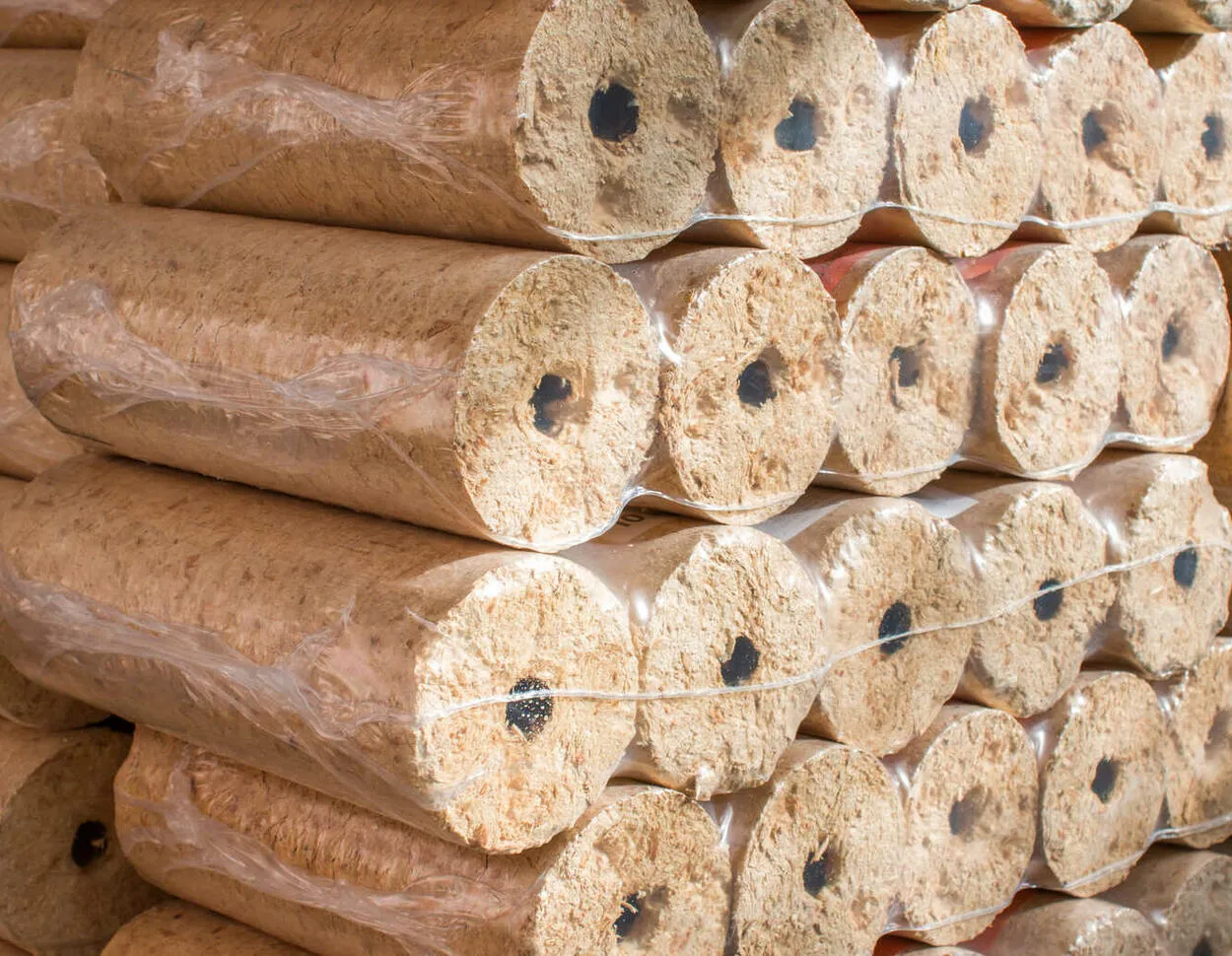
Wood briquettes are compressed wood residues with less than 10% moisture, whereas firewood in the form of untreated logs contains 15 to 25% residual moisture.
Wood briquettes are made by pressing dry shavings and sawdust into shape under high pressure. The result is a compact fuel with uniform density and very low residual moisture. The most common types in Europe are RUF briquettes, Nestro briquettes and Pini Kay briquettes. Each format has a slightly different burning time and suits different stove types.
Firewood, by contrast, is naturally grown timber split into logs and dried. Its quality depends heavily on the wood species and drying time. Ready-to-burn hardwood logs such as beech or oak provide reliable heat but require considerably more storage space than compressed briquettes. Anyone looking to buy dried firewood should look for a certified residual moisture content of no more than 20%.
Which fuel has the higher calorific value?
Wood briquettes deliver around 4.5 to 5.5 kWh per kilogram, whereas dry hardwood firewood achieves approximately 3.5 to 4.2 kWh per kilogram.
The calorific value indicates how much energy one kilogram of fuel releases when completely burned. Because wood briquettes contain almost no water, very little energy is lost through evaporation. According to the Agency for Renewable Resources (FNR), the average calorific value of hardwood RUF briquettes is approximately 5.0 kWh/kg.
The value varies more widely for firewood. Freshly cut wood can contain up to 50% water and then delivers only around 2.0 kWh/kg. Only after one to two years of drying does the residual moisture content fall to 15 to 20%, with the calorific value rising to the stated 3.5 to 4.2 kWh/kg.
The following table summarises the key figures:
| Property | Wood briquettes (hardwood) | Hardwood firewood (beech, oak) | Softwood firewood (spruce, pine) |
|---|---|---|---|
| Calorific value | 4.5 to 5.5 kWh/kg | 3.5 to 4.2 kWh/kg | 3.0 to 3.8 kWh/kg |
| Residual moisture | below 10% | 15 to 25% | 15 to 25% |
| Ash content | 0.5 to 1.5% | 1 to 3% | 1 to 2% |
| Burning time | 2 to 4 hours | 1 to 3 hours | 0.5 to 1.5 hours |
| Storage space per tonne | approx. 1.2 m³ | approx. 2.0 m³ | approx. 2.5 m³ |
| Price per kWh (approx.) | 5 to 8 cents | 6 to 10 cents | 5 to 8 cents |
| CO₂ balance | almost neutral | almost neutral | almost neutral |
Sources: FNR, C.A.R.M.E.N. e. V., DEPI (as of 2025/2026)
Which is cheaper to buy: wood briquettes or firewood?
Wood briquettes are generally 10 to 20% cheaper per kilowatt-hour than ready-to-burn firewood, particularly when buying whole tonnes.
The price per kilogram alone says little. What matters is the price per kilowatt-hour, meaning the heat you can actually use. Because wood briquettes deliver more energy per kilogram and less water needs to evaporate, heating costs are lower. According to C.A.R.M.E.N. e. V., average heating costs for wood briquettes in Germany in 2025 were approximately 6 to 8 cents per kWh, while commercially purchased ready-to-burn firewood cost 7 to 10 cents per kWh.
Ordering wood briquettes online in Germany in larger quantities provides additional savings through lower transport costs per tonne. We deliver from a minimum quantity of one tonne and offer tiered prices for full truckloads.
“The cost-effectiveness of wood heating stands or falls with fuel quality. A low moisture content is the most important factor in keeping heating costs down.” (Agency for Renewable Resources, 2025)
How should wood briquettes and firewood be stored?
Both fuels need dry, ventilated storage, but wood briquettes absolutely must be protected from any moisture.
Firewood is relatively resilient. A roofed shelter with open sides is sufficient to allow air to circulate and the residual moisture to continue falling. We have published a detailed guide to storing firewood correctly that summarises the most important rules.
Wood briquettes do not tolerate moisture. As soon as they absorb water, they swell and fall apart. Always store briquettes indoors, on pallets and away from the wall. Relative humidity below 65% is ideal. The best wood briquettes for heating are of little use if they swell in a damp basement.

Where can you order wood briquettes and firewood in Germany, Austria and Switzerland?
We deliver wood briquettes and firewood by the tonne or truckload to Germany, Austria and Switzerland.
Our warehouse is in Břežany (Czech Republic), and we supply customers throughout Central Europe. You can buy wood briquettes in Germany, buy wood briquettes in Austria or buy wood briquettes in Switzerland. You can also buy firewood online in Germany through our shop.
We prepare individual quotations for bulk buyers and resellers. Write to us using the contact form or call us directly.
Frequently asked questions about wood briquettes and firewood
How long do wood briquettes burn compared with firewood?
A wood briquette burns for two to four hours, depending on its type and stove settings. A similarly sized hardwood log lasts approximately one to three hours. The higher energy density of briquettes produces a longer, more even ember phase. Find out more in our article “How long do wood briquettes last?”.
Can you mix wood briquettes and firewood?
Yes. Many of our customers use logs to establish the fire and then add a wood briquette to keep the embers glowing overnight. The combination works equally well in wood-burning stoves, tiled stoves and boilers. Make sure both fuels are dry.
Are wood briquettes more environmentally friendly than firewood?
Both fuels are considered CO₂-neutral because combustion releases only as much carbon dioxide as the tree absorbed during its growth. The German Environment Agency confirms that wood heating using dry fuels has a positive climate balance. Wood briquettes have the additional advantage of being made from sawmill residues, so no additional trees need to be felled.
How many wood briquettes do you need for one winter?
An average household using a wood-burning stove for supplementary heating consumes approximately two to four tonnes of wood briquettes per heating season. Anyone heating exclusively with wood should allow five to eight tonnes. Exact requirements depend on insulation, living area and outdoor temperature.
Which firewood has the best calorific value?
Among native wood species, hornbeam delivers the highest calorific value at around 4.2 kWh/kg, followed by oak and beech. Ash and birch are in the middle range. For the best firewood price comparison, always convert prices to kilowatt-hours rather than stacked cubic metres. Our guide “Ash vs. oak firewood” examines the differences in detail.
You can find more answers on our Frequently Asked Questions page.
Key findings at a glance
- Wood briquettes deliver more heat per kilogram than firewood because their residual moisture content is below 10%.
- Per kilowatt-hour, briquettes are generally 10 to 20% cheaper than ready-to-burn logs.
- The storage space needed for one tonne of briquettes is only about 1.2 m³, whereas firewood requires around 2.0 m³.
- Wood briquettes absolutely must be stored dry. Firewood is less sensitive.
- Both fuels are CO₂-neutral and contribute to the energy transition.
- We deliver both options by the tonne and truckload to Germany, Austria and Switzerland.
Sources and further information:
- Agency for Renewable Resources (FNR), “Basic Bioenergy Data for Germany”, 2025.
- C.A.R.M.E.N. e. V., “Price Trends for Solid Biofuels”, 2025/2026.
- German Pellet Institute (DEPI), “Overview of Fuel Qualities and Calorific Values”, 2025.
- German Environment Agency (UBA), “Heating with Wood: How to Do It Right”, 2024.
- Federal Statistical Office (Destatis), “Energy Consumption of Private Households”, 2025.
- Bioenergy Europe, “Statistical Report 2025”, Brussels.
- Federal Ministry for Housing, Urban Development and Building, “Renewable Heat in Existing Buildings”, 2025.
wood briquette calorific value, firewood price comparison, wood briquette storage, buy RUF briquettes, firewood calorific value table