

 Čeština
 Deutsch
 Română
 Polski
 Italiano
 Español
 Nederlands
 Magyar
 Slovenčina
 Slovenščina
 Hrvatski
ENplus Certification Explained: What It Covers and Why It Should Be Non-Negotiable
When you invest in a pellet heating system, fuel quality directly determines whether you enjoy years of trouble-free warmth or face constant maintenance headaches. ENplus certification has emerged as the definitive quality standard for wood pellets, protecting consumers from substandard products while ensuring consistent heating performance. This certification scheme covers far more than you might expect, creating a comprehensive quality framework that spans the entire supply chain.
Understanding what ENplus certification actually covers helps you make informed purchasing decisions that protect both your heating equipment and your budget. At Wood-Břežany s.r.o., we’ve witnessed firsthand how certified pellets transform the heating experience for thousands of European customers.
ENplus Certification Guide: Why It’s Essential
When you choose wood pellets for heating, quality makes all the difference between efficient warmth and expensive frustration. ENplus certification represents the global gold standard for wood pellet quality, covering every step from raw material sourcing to delivery at your door. At Wood-Břežany s.r.o., we deliver ENplus A1 certified pellets across Europe because we understand that certification isn’t just a badge, it’s your guarantee of consistent performance, lower maintenance costs, and reliable heating throughout the season. This comprehensive guide explains exactly what ENplus certification covers and why you should never compromise on this critical quality standard.
What Is ENplus Certification and Why Does It Exist?
ENplus certification is a globally recognised quality assurance scheme for wood pellets that ensures consistent standards throughout the entire production and distribution chain.
The scheme was developed by the European Pellet Council in 2010 to ensure wood pellets meet high-quality standards through stringent requirements covering the whole supply chain from raw materials to customer delivery. Unlike basic product standards that only verify final product specifications, ENplus examines every stage where quality could be compromised.
The certification addresses a fundamental problem in the pellet market. As of 2026, ENplus has solved 1,460 fraud cases, demonstrating how widespread quality deception remains in this industry. Without certification, you have no reliable way to verify whether pellets meet claimed specifications until after you’ve paid for them and started burning them in your heating system.
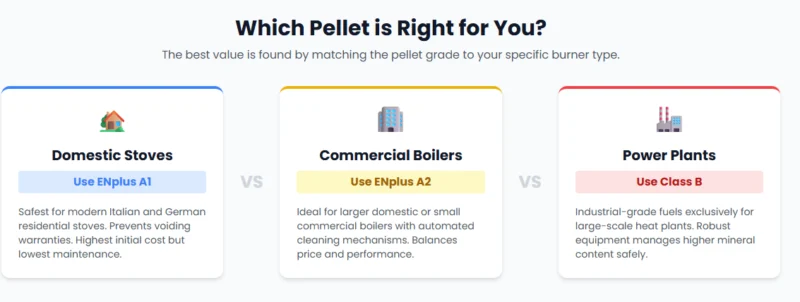
Three ENplus quality grades serve different heating applications:
- ENplus A1 – Premium residential grade with ash content below 0.7%
- ENplus A2 – Standard residential grade permitting up to 1.2% ash content
- ENplus B – Industrial grade allowing up to 3% ash content
Our ENplus A1 wood pellets represent the highest quality tier, specifically engineered for residential heating systems where performance and cleanliness matter most.
Complete Supply Chain Coverage: What ENplus Actually Monitors
ENplus certification separates itself from other quality schemes through comprehensive supply chain oversight that leaves no gaps for quality degradation.
Unlike simple ISO certification, the ENplus system covers production control checking raw material quality and technological processes, storage condition verification monitoring temperature and warehouse humidity, and transportation monitoring ensuring tightness and moisture protection.
Raw Material Quality Standards
Certification begins with raw material selection. ENplus mandates that only specific wood types can be used, with strict limits on bark content, chemical additives, and contamination. Even 20% low-quality pellets in a mixture increase ash content, increase dust formation, and reduce combustion predictability.
Production Process Requirements
Certified manufacturers must demonstrate controlled production environments with documented procedures for:
- Moisture content management during pelletisation
- Particle size consistency and mechanical durability testing
- Dust and fines reduction protocols
- Equipment calibration and maintenance schedules
Recent revisions require pellets to be analysed for particle density, coarse fines, and share of pellets below 10mm, ensuring even greater consistency than previous standards demanded.
Storage and Handling Protocols
Quality pellets can degrade rapidly under poor storage conditions. ENplus certification requires:
- Climate-controlled warehousing preventing moisture absorption
- Contamination prevention systems keeping pellets clean
- Inventory rotation procedures ensuring freshness
- Moisture monitoring during extended storage periods
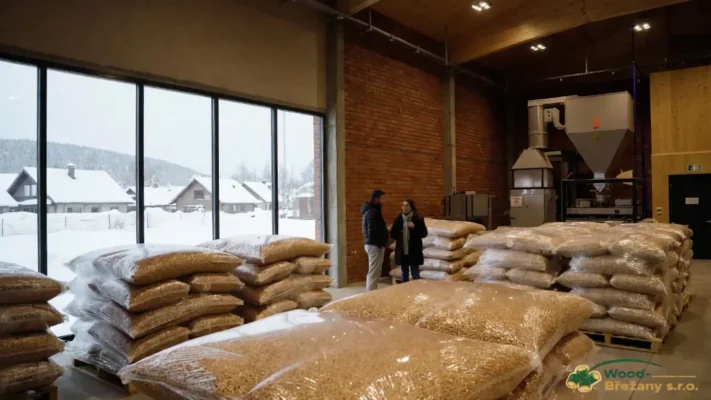
We maintain dedicated storage facilities at Wood-Břežany s.r.o. that exceed minimum ENplus requirements, guaranteeing your pellets arrive in optimal condition.
Packaging and Transport Standards
Bags for certified pellets must include a serial number allowing identification of the company that bagged the pellets, the site, and the date of bagging. This traceability prevents fraud while enabling rapid response if quality issues emerge.
Transport requirements protect pellets from:
- Moisture exposure during shipping
- Physical damage from rough handling
- Contamination from other cargo
- Temperature extremes that could affect quality
Buy ENplus A1 Certified Wood Pellets: Technical Specifications That Matter
Understanding the precise technical requirements helps you appreciate why ENplus A1 certification delivers superior heating performance.
| Parameter | ENplus A1 Requirement | Why It Matters |
|---|---|---|
| Ash Content | ≤ 0.7% | Reduces cleaning frequency by 60-75% compared to uncertified pellets |
| Moisture Content | ≤ 10% | Delivers 15-25% more heat energy per kilogram versus high-moisture pellets |
| Mechanical Durability | ≥ 98% | Prevents dust formation and ensures smooth feeding through automatic systems |
| Calorific Value | ≥ 16.5 MJ/kg | Guarantees consistent heat output for accurate temperature control |
| Diameter | 6mm ± 1mm | Ensures compatibility with standard pellet stove and boiler feed mechanisms |
| Length | 3.15-40mm | Optimises combustion efficiency and prevents jamming in feed augers |
According to research published by Biomass Conversion and Biorefinery, ENplus A1 certified pellets demonstrate superior combustion behaviour in residential heating systems, producing minimal ash residue and significantly lower emissions compared to lower-grade alternatives.
When you buy wood pellets online, these specifications translate directly into measurable benefits. Lower ash content means cleaning your heating system once every two weeks instead of every three days. Consistent moisture levels deliver predictable heat output, eliminating the temperature fluctuations that plague users of uncertified pellets.
How to Identify Authentic ENplus Certified Pellets
Certification fraud represents a serious problem in the pellet industry. The most common fraud involves production or distributor companies claiming their pellet is ENplus without actually having certification. Protecting yourself requires understanding how to verify authentic certification.
Genuine ENplus pellets display:
- Complete ENplus logo with quality grade (A1, A2, or B) clearly marked
- Unique identification number starting with 0 for producers or 3 for distributors
- Serial number on bags enabling traceability to specific production batches
- Product data sheet listing all technical specifications
- Certification body name verifying third-party assessment
You can verify any supplier’s certification status by checking the official ENplus database. This searchable directory lists all currently certified companies with their certification expiry dates and quality grades.
ENplus maintains a blacklist of fraudulent entities that have falsely claimed certification. Before purchasing from any new supplier, cross-reference their details against both the certified company database and the fraud blacklist.
At Wood-Břežany s.r.o., our certification credentials are publicly verifiable, and we provide full documentation with every delivery confirming the certified status of your pellets.
Where Can You Buy ENplus Certified Wood Pellets in Europe?
ENplus certified pellets represented approximately 75% of the European residential heating market in 2024, with certified traders handling a record 7.5 million tons. This widespread adoption means you have access to certified pellets throughout Europe, though quality and service vary significantly between suppliers.
Key factors when selecting a certified supplier:
- Current certification status verified through official ENplus database
- Delivery coverage ensuring service to your location
- Bulk purchasing options reducing per-tonne costs
- Storage capacity enabling seasonal purchase discounts
- Customer service quality providing technical support when needed
We deliver across Romania, Germany, Czech Republic, Poland, and throughout Central Europe. Our shop offers flexible ordering options from single bags to full lorry loads, with transparent pricing and reliable scheduling.
Best ENplus Wood Pellets for Residential Heating
Not all ENplus A1 certified pellets perform identically, despite meeting the same technical specifications. Material composition, production methods, and supplier reliability create meaningful differences in real-world performance.
Premium certified pellets offer:
- Consistent diameter throughout the bag, not just average measurements
- Minimal fines content reducing dust and feed system clogging
- Low resin content preventing clinker formation in heat exchangers
- Hardwood/softwood blends optimised for combustion characteristics
- Seasonal consistency maintaining specifications across production batches
Our biomass wood pellets undergo additional quality testing beyond minimum certification requirements. We monitor every production batch for combustion characteristics, ash fusion temperatures, and real-world heating performance.
Why ENplus Certification Should Be Non-Negotiable
The financial and operational consequences of using uncertified pellets far exceed any initial purchase savings. Understanding these impacts demonstrates why ENplus certification represents essential protection rather than optional preference.
Equipment Protection and Longevity
Low-quality pellets create problems including uneven combustion leading to overheating of the combustion chamber, excessive ash formation clogging heat exchangers, and high moisture content reducing boiler efficiency by 15-25%.
Modern pellet boilers and stoves represent significant investments, often costing between €3,000 and €15,000 depending on heating capacity. Uncertified pellets can void manufacturer warranties while accelerating wear on:
- Combustion chamber liners damaged by excessive temperatures
- Heat exchanger surfaces fouled by high ash residue
- Feed auger mechanisms jammed by oversized or irregular pellets
- Ignition systems stressed by inconsistent fuel quality
Maintenance Cost Reductions
Certified pellets reduce both maintenance frequency and complexity. Quality pellets reduce equipment wear and significantly extend service life, with 3-4 times less ash compared to non-certified pellets.
Annual maintenance comparison (typical residential installation):
| Maintenance Item | With Certified Pellets | With Uncertified Pellets |
|---|---|---|
| Ash removal frequency | Every 10-14 days | Every 3-5 days |
| Heat exchanger cleaning | Twice per season | 4-6 times per season |
| Feed system servicing | Once per season | 2-3 times per season |
| Professional service calls | 1-2 annually | 3-5 annually |
These differences translate into 50-150 hours of saved time and €200-500 in reduced service costs per heating season.
Predictable Fuel Consumption
If you burn five tons of pellets per heating season, using pellets with 10% moisture content versus pellets with 15% moisture translates to receiving approximately 250 kilograms less actual fuel energy.
Certified pellets enable accurate seasonal fuel budgeting. You can calculate heating costs with confidence, knowing your pellets will deliver consistent calorific values throughout the delivery. Uncertified pellets introduce uncertainty that makes financial planning impossible.
Environmental Performance
Certification ensures pellets meet emissions standards that protect air quality. Lower ash content and complete combustion reduce particulate emissions by 40-60% compared to poor-quality pellets.
For users accessing government heating incentives like the UK’s Renewable Heat Incentive, ENplus A1 certification is a legislative requirement for wood pellets listed on the Biomass Suppliers List.
How Long Do ENplus Certified Pellets Last in Storage?
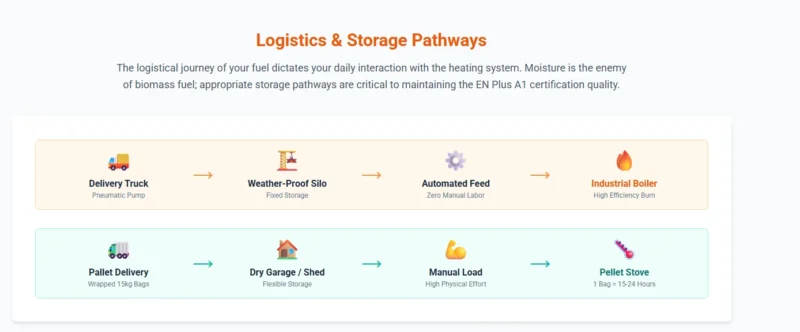
Proper storage maximises your investment in certified pellets. Even premium pellets degrade if exposed to moisture or temperature extremes.
Storage best practices:
- Indoor storage in climate-controlled spaces when possible
- Palletised storage keeping bags off concrete floors
- Moisture barriers using plastic sheeting in unheated spaces
- Air circulation preventing condensation around bag stacks
- First-in-first-out rotation ensuring freshness
Properly stored ENplus certified pellets maintain quality for 12-18 months. Moisture absorption represents the primary degradation mechanism. Pellets exposed to humidity above 60% begin absorbing moisture within weeks, reducing calorific value and mechanical durability.
We recommend purchasing seasonal quantities (October-November for the heating season) rather than multi-year stockpiles. This approach balances bulk purchase discounts against storage complexity while ensuring optimal pellet condition.
What does ENplus certification actually verify?
ENplus certification verifies pellets meet strict technical specifications covering 18 different parameters including ash content, moisture levels, mechanical durability, and calorific value. The scheme operates as a third-party certification with conformity assessed by accredited independent organisations. Certification also confirms proper supply chain management practices throughout production, storage, and distribution.
Can I trust ENplus certification claims on pellet bags?
Always verify certification independently through the official ENplus database before purchasing. Companies suspended from certification sometimes continue selling pellets as ENplus after their certificate expires. Check the certification number against the current database and confirm the expiry date matches. Genuine certified suppliers welcome verification requests.
How much more expensive are ENplus certified pellets?
Certified pellets typically cost 5-15% more per tonne than uncertified alternatives at purchase. However, reduced maintenance costs, lower consumption rates due to higher energy density, and extended equipment life make certified pellets 20-40% more cost-effective over a full heating season. The apparent savings from cheaper uncertified pellets disappear rapidly through increased ash removal time, additional service calls, and reduced heating efficiency.
Do all pellet stoves require ENplus certified fuel?
Manufacturer warranties increasingly specify certified pellets as a requirement for warranty validity. The Environmental Protection Agency in the United States has ruled that all new pellet stove warranties must specify the use of certified pellets. Even if your warranty doesn’t mandate certification, using certified pellets protects your investment by preventing damage from substandard fuel.
How often does ENplus certification need renewal?
ENplus certification is valid for three years and includes annual surveillance inspections and a certification inspection every three years. This ongoing oversight prevents quality drift over time and ensures certified suppliers maintain consistent standards throughout the certification period. Suppliers must demonstrate continued compliance at each inspection to retain certification status.
What happens if I receive non-compliant certified pellets?
ENplus requires companies to address all quality complaints via strict procedures. Report issues immediately to your supplier and to the national ENplus licenser in your country. Document the problem with photographs and retain samples for potential testing. Certified suppliers must investigate complaints and provide corrective action or replacement product. Persistent quality failures can result in certification suspension.
Where can I buy high-quality ENplus A1 pellets in Romania?
Wood-Břežany s.r.o. delivers premium ENplus A1 certified wood pellets throughout Romania with transparent pricing and reliable scheduling. We maintain full certification documentation and welcome verification through the official ENplus database. Our contact page provides direct communication channels for technical questions and ordering assistance.
References
- European Pellet Council. (2026). 10 Benefits of ENplus Certification
- Bioenergy Europe. (2025). Pellets Statistical Report 2025
- European Pellet Council. (2026). ENplus Certification Scheme
- Biomass Conversion and Biorefinery. (2025). Combustion Behavior of ENplus A1 Certified Pellets
- Control Union. (2025). ENplus Whole Chain Certification Guide
- UK Pellet Council. (2026). Pellet Consumers Survey 2026
- European Pellet Council. (2025). ENplus Celebrates 15 Years