

 Čeština
 Deutsch
 Română
 Polski
 Italiano
 Español
 Nederlands
 Magyar
 Slovenčina
 Slovenščina
 Hrvatski
The Science of Wood Pellet Storage: Humidity, Compression and Quality Degradation Explained
Proper wood pellet storage is not simply about finding a dry corner in your shed. From the moment a pellet leaves the production line, a slow competition begins between its compressed fibre structure and the environment around it. Moisture, compressive load, temperature cycling, and even invisible gas emissions are all quietly working against fuel quality. At Wood-Břežany s.r.o., we supply certified wood pellets to customers across Europe, and we see the real-world consequences of poor storage every single heating season. This post walks through the exact science behind wood pellet storage degradation, so you can protect both your investment and your boiler.
Wood Pellets for sale
Our certified ENplus A1 wood pellets are produced from sustainably sourced Central European timber, with moisture content consistently below 10% and ash content under 0.7%. Every batch meets strict DINplus and ENplus A1 quality standards, delivering reliable heat output, minimal residue, and outstanding mechanical durability above 97.5%. Available in 15 kg bags, 975 kg pallets, and bulk formats with fast delivery across Europe. Our pellets are engineered to withstand correct storage conditions for up to 18 months without quality loss. Order from our shop today.

What Happens to Wood Pellets When They Absorb Moisture?
Wood pellet storage quality collapses fastest through moisture absorption. Pellets are compressed wood fibre held together by lignin, the natural polymer found within timber. According to the ENplus certification standard, premium A1 pellets must maintain moisture content below 10% at the point of delivery.
Research published in Fuel Processing Technology confirms that pellets can absorb water in a high-humidity environment, causing increases in moisture content, a reduction in pellet strength, higher attrition rates, and significantly more dust generation. The breakdown sequence works like this:
- Cellulose fibres in the wood absorb water molecules from the surrounding air.
- The fibres expand laterally, fracturing the compressed cylindrical structure.
- Lignin bonds weaken progressively, reducing the pellet to a crumbly, powder-like mass.
- The resulting fines and dust clog feed augers, stove mechanisms, and boiler components.
A pellet that crumbles at the touch has already failed as a fuel. It will not ignite efficiently, it will not flow through automated systems reliably, and the excess moisture it carries into the combustion chamber reduces heat output while increasing residue.
Why Is Relative Humidity the Single Biggest Threat to Stored Pellets?
Relative humidity (RH) above 65% is where measurable pellet deterioration begins. A controlled laboratory study published in Fuel Processing Technology found that exposure to 90% RH coupled with elevated temperatures caused a 50 to 92% decrease in shear modulus compared to fresh pellets after just four days, with white wood pellets disintegrating entirely during testing.
Wood pellets are hygroscopic, meaning they actively draw moisture from the surrounding air rather than requiring direct water contact. A bag left in an unventilated outbuilding, damp basement, or near exposed pipework will pull moisture through its packaging if the ambient humidity is persistently high.
Research indicates that humidity levels between 20% and 60% do not cause significant degradation for woody pellets, but degradation accelerates sharply at RH values above 90%.
Practical humidity thresholds for wood pellet storage:
| Relative Humidity Level | Risk to Pellet Quality | Recommended Action |
|---|---|---|
| Below 50% | Low | Safe for long-term storage, no action needed |
| 50% to 65% | Moderate | Monitor regularly, keep bags sealed at all times |
| 65% to 80% | High | Relocate stock to a drier environment immediately |
| Above 80% | Critical | Significant quality degradation likely within days |
Our ENplus A1 certified pellets arrive in moisture-resistant packaging designed to delay ingress, but no packaging replaces correct storage conditions. For an in-depth breakdown of moisture standards across pellet grades, read our wood pellet moisture content guide.
How Does Compression Damage Wood Pellet Quality Over Time?
Compression damage receives far less attention than moisture but is equally destructive during long-term wood pellet storage. Pellets are already a compressed product, formed under pressures of 150 to 300 MPa during manufacturing, with structural integrity depending on precise pressure release and cooling.
When pallets or bags are stacked too high, the weight of upper layers exerts continuous downward force on those below. This is called creep loading, and it produces micro-fractures along the pellet length. These fractures do not always split the pellet immediately. Instead, they create structural stress lines that cause the pellet to break apart the moment it meets the mechanical action of an auger or feed screw.
How High Can You Safely Stack Pellet Pallets?
According to standard biomass handling guidelines across the European industry, a full 975 kg pallet of bagged pellets should not be stacked more than two pallets high. Exceeding this creates a compressive load on the bottom layer that damages both packaging integrity and pellet structure.
For bulk storage in silos or bunkers, the same principle applies. Research published in Communications Materials (Nature) confirmed that extended storage at combined heat and humidity conditions caused higher pellet porosity, weight gain, increased inclusion body formation, and an internal network of cracks throughout the pellet microstructure. Poorly designed storage rooms without sloped floors or adequate aeration allow pellets at the base to compress and fuse, making automated feeding nearly impossible.
Which Temperature Fluctuations Cause the Most Storage Damage?
Temperature cycling is the third pillar of pellet quality degradation. When stored pellets move through repeated warm and cold cycles, the cellulose, hemicellulose, and lignin components within them expand and contract at slightly different rates. This internal tension weakens the pellet structure steadily over weeks and months.
Condensation compounds the problem. When a cold surface, such as a concrete floor or a metal storage container, is surrounded by warmer, humid air, water vapour condenses directly on that surface. Pellets stored on cold floors absorb this condensation from below, even through sealed bags. A study published in Scientific Reports (2024) found that all tested pellet types reached full moisture saturation within two days when held at 30°C and 90% RH, with the amount of absorbed moisture depending heavily on the type of material and its hygroscopic properties.
Ideal storage temperature range: 5°C to 20°C, with minimal fluctuation throughout the storage period. This is particularly relevant for European buyers purchasing large volumes in autumn for winter use, as many outdoor storage solutions are exposed to freezing temperatures followed by warmer spells.
For detailed guidance tailored to European buyers, visit our wood pellet storage resource and our complete wood pellets guide for 2026.
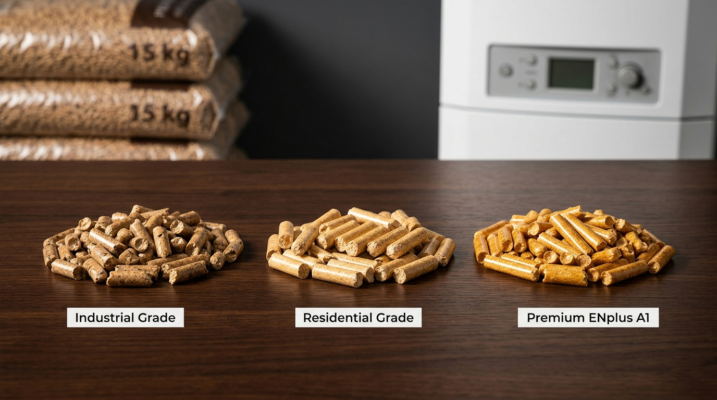
Buy ENplus A1 Wood Pellets Built for Long-Term Storage Performance
Not all pellets degrade at the same rate. Pellet density, diameter tolerance, mechanical durability, and ash content all influence how well a pellet survives storage conditions. Our ENplus A1 wood pellets are tested to mechanical durability standards above 97.5%, meaning fewer than 2.5% of pellets fracture during normal handling. This figure matters enormously in storage, since higher-durability pellets resist compression cracking and moisture ingress far longer.
A long-term stockpile study showed that indoor stored steam-exploded pellets exhibited only a 3% decrease in durability after twenty months, while outdoor stored pellets saw durability drop from 92% to just 22% after three months during a high-humidity summer period.
Storage performance comparison by pellet grade:
| Pellet Grade | Mechanical Durability | Moisture Sensitivity | Safe Storage Duration |
|---|---|---|---|
| ENplus A1 | Above 97.5% | Low (below 10% MC) | Up to 18 months |
| ENplus A2 | Above 97.5% | Moderate | Up to 12 months |
| ENplus B | Above 96.5% | Higher | 6 to 9 months |
| Industrial Grade | Variable | High | 3 to 6 months |
For a full grade-by-grade breakdown, read our ENplus A1 vs A2 vs B pellets comparison. You can also find our best wood pellets for UK and European buyers if you are comparing suppliers.
What Is Outgassing and Why Does It Make Pellet Storage Dangerous?
Outgassing is a storage risk that almost no retailer discusses openly but is a genuine safety concern for anyone storing pellets indoors. Fresh wood pellets, particularly softwood varieties, release carbon monoxide (CO) and carbon dioxide (CO2) as a result of ongoing biological activity within the wood fibre after production.
Research published in Energy and Fuels found that CO concentrations in domestic and commercial-scale pellet bins can exceed guidance and regulatory exposure limits, with higher relative humidity environments causing higher CO emission rates via biological activity and oxidation of wood components.
In well-ventilated storage areas, these concentrations remain safe. In sealed or poorly ventilated spaces, such as underground bunkers or airtight utility rooms, CO levels can accumulate to hazardous concentrations within days of delivery. The German Federal Institute for Risk Assessment has issued specific guidance recommending daily ventilation of pellet storage rooms, particularly during the first two weeks after a new delivery.
This is especially important for customers purchasing bulk biomass wood pellets connected to automated feeding systems with enclosed storage rooms. Ensure your boiler room or bunker has a ventilation route that cannot be sealed off.
“The quality you receive from a wood pellet supplier only stays with you as long as your storage conditions allow it. Correct humidity, correct stacking, and correct ventilation are not extras, they are essentials.” Wood-Břežany s.r.o., Certified Wood Fuel Specialists, Czech Republic
How to Store Wood Pellets Correctly: Best Practices Checklist
Correct wood pellet storage can extend usable pellet life by 50% or more, according to industry handling guidelines. Follow these steps every time:
- Store pellets on a raised wooden pallet, never directly on concrete or stone.
- Keep the storage area at a stable temperature between 5°C and 20°C.
- Maintain relative humidity below 65%, using a dehumidifier if necessary.
- Never stack bagged pallets more than two pallets high.
- Ventilate the storage room daily, particularly for the first two weeks after delivery.
- Keep pellets well away from heat sources, water pipes, and external walls exposed to rain.
- Rotate stock on a first-in, first-out basis so older pellets burn first.
- Check bags regularly for swelling, dust accumulation, discolouration, or unusual odour.
You can browse our full certified range at the Wood-Břežany online shop, or contact us via our customer support page if you need guidance on storage solutions for larger volumes.
Key Takeaways
- Moisture is the primary enemy. Relative humidity above 65% begins destroying pellet structure within days, well before any visible damage appears.
- Compression matters as much as moisture. Stack height, pallet loading, and bunker design all affect the structural integrity of pellets over time.
- Temperature cycling triggers condensation. Always raise pellets off cold floors and away from surfaces prone to moisture accumulation.
- Outgassing is a genuine safety risk. Ventilate pellet storage rooms properly after every new delivery, particularly in enclosed spaces.
- Pellet grade directly determines storage resilience. ENplus A1 pellets retain quality significantly longer than lower-grade alternatives.
- Correct storage can extend pellet life by up to 50%, protecting both your heating investment and your boiler or stove components.
Wood Pellet Storage Science
What is the ideal humidity level for wood pellet storage?
The ideal relative humidity for wood pellet storage is below 65%. At or above this level, pellets begin absorbing moisture from the air, which weakens lignin bonds and causes the pellets to swell, crack, and crumble over days or weeks.
How long can wood pellets be stored without losing quality?
ENplus A1 certified pellets stored in correct conditions can retain full quality for up to 18 months. Lower-grade pellets degrade considerably faster, particularly in areas with fluctuating temperature or persistently high humidity during European autumn and winter months.
Can wood pellets be stored outdoors in European climates?
Wood pellets should not be stored outdoors without proper weatherproof covering. In European climates, seasonal rainfall, frost, and temperature swings cause rapid moisture absorption and compression damage within weeks when pellets are unprotected or improperly covered.
Why do my stored wood pellets turn to dust and crumble?
Pellets crumble when moisture breaks down the lignin binders holding compressed wood fibre together. Poor ventilation, high ambient humidity, direct contact with damp surfaces, and excessive stacking pressure are the most common causes of this problem.
Is it safe to store large quantities of wood pellets in a room inside my home?
Yes, provided the room is well ventilated. Fresh pellets emit carbon monoxide and carbon dioxide as part of a natural outgassing process. Any room used for pellet storage should have a working ventilation path and should be aired daily for at least two weeks after a new delivery, particularly for bulk quantities above 500 kg.
References and Citations
- Graham, S. et al. (2016). Changes in mechanical properties of wood pellets during artificial degradation in a laboratory environment. Fuel Processing Technology, Elsevier.
- Tiringer, U. et al. (2021). Microstructural degradation during the storage of biomass pellets. Communications Materials, Nature Portfolio.
- Deng, L. et al. (2018). Influences of environmental humidity on physical properties and attrition of wood pellets. Fuel Processing Technology, Elsevier.
- Graham, S. et al. (2017). Mechanical degradation of biomass wood pellets during long term stockpile storage. Fuel Processing Technology, Elsevier.
- Ferreira, J. et al. (2024). Effect of storage conditions on lignocellulose biofuels properties. Scientific Reports, Nature.
- Ferge, L.A. et al. (2015). Measurement and Modeling of Carbon Monoxide Emission Rates from Multiple Wood Pellet Types. Energy and Fuels, ACS Publications.
- Wood-Břežany s.r.o. (2026). Wood Pellet Storage Guide. woodbrezany.com.