
 Čeština
 Deutsch
 Română
 Polski
 Italiano
 Español
 Nederlands
 Magyar
 Slovenčina
 Slovenščina
 Hrvatski
Buy wood briquettes now: order RUF, Nestro and Pini Kay in bulk.
At Wood-Břežany, we deliver wood briquettes in all three main formats—RUF, Nestro and Pini Kay—directly by the pallet or in full truckloads to Germany, Austria, Switzerland and other European countries.
Our briquettes consist of pure, chemical-free compressed wood with residual moisture below 10 per cent and a calorific value between 4.7 and 5.3 kWh/kg. Every delivery is traceable and packaged by type, so you receive exactly what you ordered.
What we offer:
- RUF wood briquettes made from hardwood or softwood, pressed into rectangular blocks, ideal for stacking and quick lighting.
- Nestro wood briquettes, cylindrical with a central hole, for even, long-lasting embers, particularly suitable for overnight use.
- Pini Kay wood briquettes, densely compressed with a central air channel, are the hottest-burning format in this comparison.
- Bark briquettes (RUF Bark), an economical fuel containing natural raw materials.
We deliver from 1 pallet (960 kg) up to full truckloads (22–24 tonnes), ideal for resellers, heating contractors, farms and commercial buyers. For large quantities, contact us directly for an individual quotation.
You can buy wood briquettes in Germany or contact us to order by the pallet. Further information about our company is available on our About Us page.
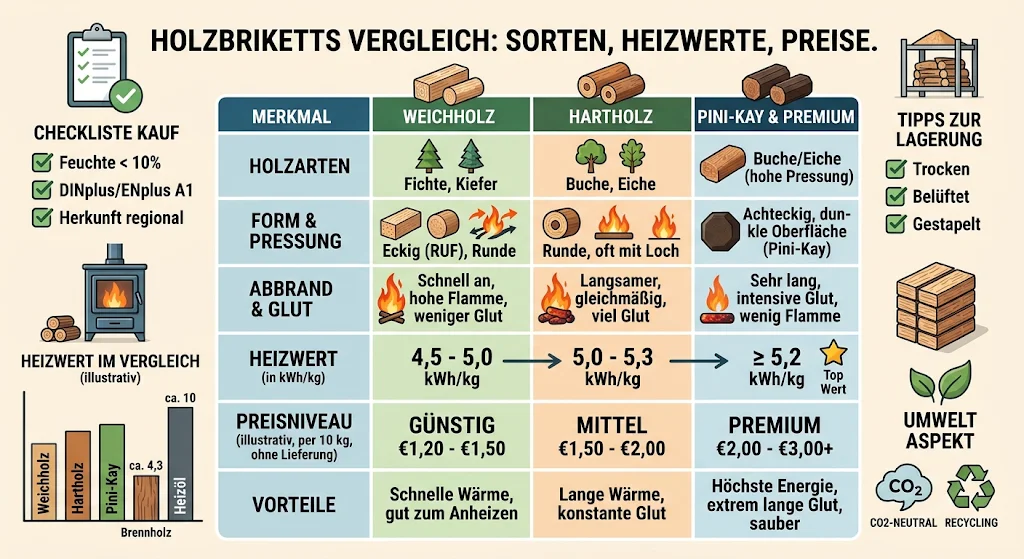
Wood briquette comparison: types, calorific values, prices
Wood briquettes compared in 2026: types, calorific values and prices
Anyone using wood briquettes in a fireplace, wood-burning stove or central heating system will sooner or later face a real choice: RUF, Nestro or Pini Kay? Hardwood or softwood? A pallet or a truckload? This comparison provides specific figures for calorific values, prices and applications, so you can buy based on facts rather than intuition.
At Wood-Břežany, we supply customers throughout Europe with wood briquettes in every format and quantity, and we know buyers’ questions from our daily operations. That experience informs this article.
What exactly are wood briquettes?
Wood briquettes are compressed wood residues from the sawmilling and wood-processing industries, compacted into solid blocks without binders. The natural wood adhesive, lignin, holds the material together.
The result is a fuel with residual moisture below 10 per cent and consistently high energy content that often exceeds that of dry logs. Wood briquettes have a calorific value of 17 to 19 MJ/kg, while firewood achieves only 14 to 16 MJ/kg.
Which types are available, and how do they differ?
RUF, Nestro and Pini Kay are the three dominant formats on the European market. Each shape has a different compression density and combustion behaviour and is better suited to particular stove types.
RUF is a small rectangular block, Nestro a solid cylinder and Pini Kay a dense block with a central air hole. Pini Kay generally burns hottest, Nestro is the longest, and RUF is the easiest to stack and light.
Energy content per kilogram is similar for all three types. Industry figures put typical briquette values at 16 to 18 MJ/kg, equivalent to approximately 4.4 to 5.0 kWh/kg. The noticeable difference when heating comes from density and shape, rather than the energy content of the wood itself.
Comparing calorific values and properties of all three types
| Feature | RUF | Nestro | Pini Kay |
|---|---|---|---|
| Shape | Rectangular | Cylindrical, with a hole | Square, with a hole |
| Calorific value (kWh/kg) | 4.6 to 5.0 | 4.7 to 5.1 | 4.8 to 5.3 |
| Calorific value (MJ/kg) | approx. 16.5 to 18 | approx. 17 to 18.4 | approx. 17.5 to 19 |
| Burning time | Medium | Long | Too long, very long |
| Flame display | Medium | Medium | High |
| Stackability | Very good | Good | Good |
| Lighting speed | Fast | Medium | Medium |
| Wood species (typical) | Hardwood or softwood | Hardwood | Hardwood |
| Ash content | up to 1.0% | up to 1.5% | up to 1.0% |
| Price per pallet (approx.) | from €280/960 kg | from €290/960 kg | from €300/960 kg |
Source: Wood-Břežany information, confirmed by industry data (2026)
What is the actual calorific value of wood briquettes?
High-quality hardwood briquettes deliver 4.8 to 5.3 kWh per kilogram, and softwood briquettes 3.8 to 4.6 kWh/kg, with residual moisture below 10 per cent.
This value depends heavily on the wood species and moisture content. Pini Kay and premium RUF wood briquettes can achieve calorific values above 5 kWh/kg, equivalent to approximately 18 MJ/kg.
Briquettes made from hardwood such as beech or oak produce approximately 5.0 to 5.3 kWh/kg of heat.
High-quality briquettes range between 4.6 and 5.2 kWh/kg. Values below 4.5 kWh/kg indicate residual moisture or inferior raw materials.
A useful comparison: the calorific value of 1,000 kg of wood briquettes is equivalent to approximately 500 litres of heating oil or 500 m³ of natural gas.
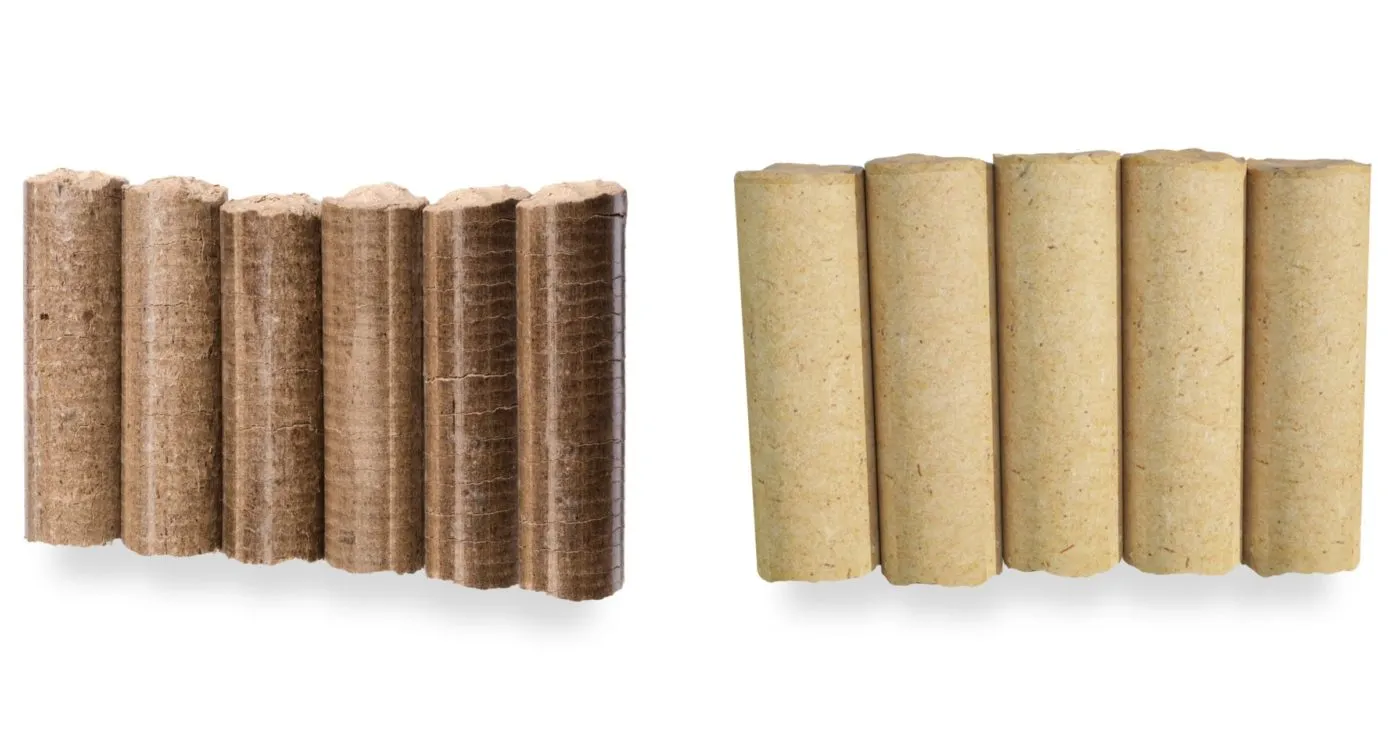
Calorific values of different wood species in briquette form
| Wood species | Briquette calorific value (kWh/kg) | Calorific value (MJ/kg) | Burning characteristics |
|---|---|---|---|
| Beech | 5.0 to 5.2 | approx. 18 | Hot, even |
| Oak | 5.1 to 5.3 | approx. 18.5 | Very hot, long-lasting embers |
| Birch | 4.8 to 5.1 | approx. 17.5 | Good, attractive flames. |
| Softwood (spruce/pine) | 4.6 to 4.8 | approx. 16.5 | Fast, shorter |
| Bark | 4.3 to 4.7 | approx. 16 | Inexpensive, more ash |
How much do wood briquettes cost in Germany in 2026?
Wood briquettes cost an average of 280 to 480 euros per tonne (960 kg pallet), depending on type, wood species and purchase quantity.
In the second quarter of 2026, wood briquette prices averaged 431.42 euros per tonne nationwide.
Wood briquettes (RUF and Pini Kay) have an average price of 280 to 330 euros per tonne, resulting in costs of 0.065 to 0.075 euros per kWh.
Buying in bulk, meaning a truckload of 20 to 24 tonnes or more, can significantly reduce the price per kilogram. At Wood-Břežany, we offer exactly that: buy wood briquettes in Germany by the pallet or truckload, directly without intermediaries.
The cheapest wood briquette pallet in the comparison costs approximately 325 euros, including shipping.
Those who prefer softwood briquettes pay less. Softwood briquettes are the cheapest, at around 238 euros per pallet.
Premium hardwood varieties or oak Pini Kay formats command higher prices, reflecting their significantly better calorific value and longer burning time. A complete overview of our products is available in our shop.
Which type suits which stove?
RUF suits small stoves and fireplace rooms. Nestro is suitable for overnight use. Pini Kay is the first choice for large rooms and maximum heating output.
RUF is a stackable rectangular block that is easy to light and suitable for small stoves. Nestro is a cylinder with long, even combustion, suitable for overnight use. Pini Kay is the densest type, with a central hole for air supply and generally the hottest combustion.
Pini Kay is particularly suitable for houses and flats with high walls, large rooms and fireplaces or wood-burning stoves with natural-stone cladding.
A comparison of the three formats and their typical applications:
Which type of wood briquette suits your heating needs?
| Requirement | Recommended type |
|---|---|
| Quick lighting | RUF |
| Long, even burning | Nestro |
| Maximum heating output | Pini Kay |
| Small wood-burning stove | RUF |
| Large living space or open fireplace | Pini Kay |
| Overnight use, continuous operation | Nestro |
| Most economical price-to-calorific-value ratio | RUF softwood |
| Highest heat output per kg | Pine Kay Oak |
Why are wood briquettes better than loose firewood?
Wood briquettes are drier, more compact and more uniform than logs, resulting in a higher calorific value, less soot and lower space requirements.
Briquettes deliver up to 80 per cent more energy per unit of volume than wood. In practice, however, what matters is how dry the wood is and how cleanly the stove burns.
Their uniform density and low residual moisture mean wood briquettes generally burn more cleanly than firewood.
Other advantages at a glance:
- Storage: A pallet of briquettes requires less space than the equivalent stacked cubic metres of logs.
- Handling: Ready-packed in 10 kg packages or loose on pallets, with no chopping or drying.
- Predictability: Consistent quality, unlike logs, which vary widely depending on drying and wood species.
- Cost-effectiveness: Lower costs per kWh than many other heating energy sources, particularly for bulk purchases.
You can find a direct cost comparison per kWh between wood briquettes, firewood and pellets in our detailed article at woodbrezany.com/en/wood-briquettes-vs-firewood-vs-pellets-cost-per-kwh.
And if you are considering whether wood briquettes or traditional firewood are the better choice for your home, read our article “Wood briquettes or firewood: calorific value and price” for a detailed analysis.
How long does a pallet of wood briquettes last?
A 960 kg pallet of hardwood briquettes provides 4 to 6 weeks of heating for a medium-sized home (100 to 120 m²), depending on the intensity of use.
This guideline applies when operating the wood-burning stove for 6 to 8 hours daily. With lower consumption, such as heating only in the evenings, a pallet can last considerably longer.
Pini Kay briquettes burn for around 40 minutes and smoulder for up to 200 minutes.
More details on burning time are available in our article “How long do wood briquettes last?
Where can you buy wood briquettes cheaply in Germany?
The best way to buy cheaply is directly from a wholesaler, by the pallet, outside the main October-to-February heating season.
At Wood-Břežany, we supply wood briquettes in Germany, wood briquettes in Austria and wood briquettes in Switzerland in pallet quantities from 960 kg. For commercial buyers, resellers or businesses with high demand, we offer truckload deliveries.
Anyone looking to buy RUF wood briquettes will find pure hardwood quality from sustainable forestry with us. Our Nestro wood briquettes and Pini Kay briquettes are packaged directly at the factory and delivered with traceable origins.
A good time to buy is from April to August. Outside the heating season, suppliers have more available storage capacity and demand is lower.
For more money-saving tips, read our guide to buying wood briquettes cheaply.
What is the difference between RUF, Nestro and Pini Kay wood briquettes?
RUF is a rectangular block, Nestro a solid cylinder with a central hole and Pini Kay a denser compressed block with an air channel. Calorific value per kilogram is similar; Nestro burns longest and Pini Kay hottest.
What calorific value do beech wood briquettes have?
The calorific value of beech Pini Kay wood briquettes is approximately 5.2 kWh per kg. Beech RUF briquettes range from approximately 4.8 to 5.0 kWh/kg.
How much do wood briquettes cost per pallet in Germany in 2026?
In the second quarter of 2026, wood briquette prices averaged 431.42 euros per tonne nationwide. Buyers can obtain better terms through direct wholesale delivery or by purchasing several pallets.
Are wood briquettes better for heating than wood pellets?
Briquettes are better suited to wood-burning stoves and open fireplaces because they are loaded manually. Pellets are used in automated heating systems. Calorific value is comparable, but handling is fundamentally different. See the comparison under Wood briquettes vs wood pellets: cost per kWh.
How can I recognise high-quality wood briquettes?
Look for a calorific value of at least 4.6 kWh/kg, ash content below 1.5 percent and residual moisture below 10 percent. High-quality briquettes range between 4.6 and 5.2 kWh/kg. Values below 4.5 kWh/kg indicate residual moisture or inferior raw materials. Further advice is available in our guide to wood briquettes.
Can you mix RUF and Nestro briquettes?
Yes. Many users light the fire with RUF and add Nestro to produce long-lasting embers. The formats are technically compatible, provided the stove is designed for briquettes.
When are wood briquettes worthwhile compared with firewood?
Briquettes are particularly worthwhile if you do not want to dry and store firewood yourself. A calculation illustrates the difference: for an annual requirement of 3,000 kWh, you need around 612 kg of briquettes at 4.9 kWh/kg. Air-dried firewood at 4.0 kWh/kg requires around 750 kg.
Firewood often costs less per kilogram if you cut it yourself. In that case, you must include your time, drying time and storage space in the calculation.
How should you store wood briquettes?
Moisture reduces usable calorific value. Store briquettes dry and well ventilated, for example under a roof or in a dry basement. Do not place pallets directly on wet ground.
What should you look for when buying wood briquettes?
Check three things before ordering:
- Residual moisture: Briquettes with no more than 10 to 12% moisture deliver their full calorific value.
- Standard: DIN EN 17225-3 specifies requirements for calorific value, moisture and ash. Stove manufacturer Brunner identifies wood briquettes meeting this standard as suitable:
“Wood briquettes according to DIN EN 17225-3, Class A1”
Source: Brunner, Iron Dog 07 operating instructions
- Pack size: A 960 kg pallet with 96 bags of 10 kg each is worthwhile for continuous use. Smaller packs are sufficient for occasional heating.
How do you order wood briquettes from Wood-Břežany?
You will find all types in our buy wood briquettes online in Germany category. If you are unsure which type suits your stove, write to us through the contact page. We also offer wood pellets; see buy wood pellets.
Free delivery applies only within the Czech Republic. For deliveries to other countries, shipping charges depend on quantity and destination. You will see the exact amount in the shop before ordering.
Frequently asked questions about wood briquettes
How many kWh does one kilogram of wood briquettes contain?
Depending on the source, one kilogram of wood briquettes delivers approximately 4.7 to 5.4 kWh. We use 4.9 kWh/kg for calculations because this value falls within the figures provided by the Technical University of Munich and the LWF.
Are wood briquettes cheaper than firewood?
They can be cheaper per kilowatt-hour, particularly if you do not dry firewood yourself. For an annual requirement of 3,000 kWh, you need around 612 kg of briquettes compared with around 750 kg of air-dried firewood.
Which wood briquettes are suitable for a wood-burning stove?
First check your stove manufacturer’s specifications. Stove manufacturer Brunner identifies briquettes according to DIN EN 17225-3, Class A1, as suitable. The shape and size should fit the combustion chamber.
How long do wood briquettes burn?
Burning time depends on the stove’s output. The calorific-value calculator at rechner-portal.de gives around 1.5 kg per operating hour for a 6 kW stove using 4.9 kWh/kg. Then multiply your quantity in kilograms by this consumption to estimate the duration.
What does the DIN EN 17225-3 standard mean?
The standard specifies requirements for solid biofuels, including wood briquettes. It describes calorific value, water content and ash content, as well as classes for domestic heating.
Key takeaways
- Wood briquettes deliver approximately 4.7 to 5.4 kWh per kg, depending on the source. A value of 4.9 kWh/kg is suitable for calculations.
- Residual moisture determines usable calorific value, so store briquettes dry.
- List prices in 2026 are 0.59 to 0.70 euros per kg, or 12 to 14 cents per kWh.
- Briquettes are particularly worthwhile if you do not dry firewood yourself.
- Check the standard, moisture and pack size before ordering.
References
- Energie-Experten: Wood Briquette Types, Calorific Values & Costs Compared
- HEIZFUXX Wood Briquette Comparison: Which Wood Briquettes Are Best?
- GW-Bio: Calorific Values of Pini Kay and RUF Wood Briquettes
- Schönbucher: Wood Briquette Calorific Value Comparison 2026
- Wood-Břežany: RUF vs. Nestro vs. Pini Kay Briquettes
- Holzharry: How Much Do Wood Briquettes Cost? Prices Compared
- infire.de: Wood Briquettes vs. Firewood Comparison 2026