
 Čeština
 Deutsch
 Română
 Polski
 Italiano
 Español
 Nederlands
 Magyar
 Slovenčina
 Slovenščina
 Hrvatski
How does the calorific value of wood briquettes compare?
The calorific value of wood briquettes ranges from 4.5 to 5.5 kWh/kg, exceeding conventional logs by up to 30 per cent. Heating with wood briquettes gives you more usable energy per kilogram of fuel than most other solid biomass products. In this article, we put the figures into context, compare briquette types and show what really matters when buying.
Wood briquettes deliver a calorific value of 4.5 to 5.5 kWh/kg. We compare RUF, Pini Kay and Nestro by energy content and moisture to help you buy.
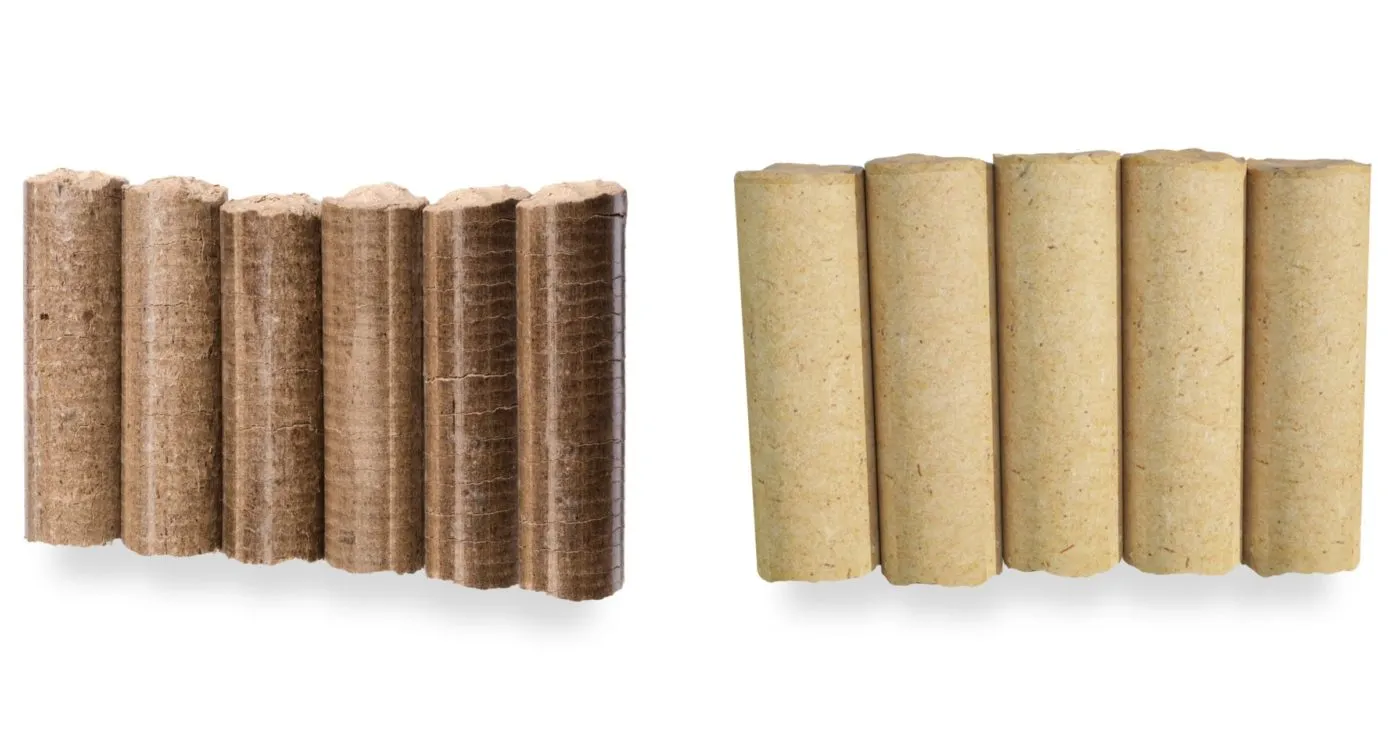
Order high-calorific-value wood briquettes online.
Are you looking for wood briquettes with a reliable calorific value for your heating system or wood-burning stove? At Wood-Břežany, we deliver wood briquettes in large quantities directly to your location throughout Europe. Our range includes RUF wood briquettes, Pini Kay briquettes and Nestro wood briquettes, each with a calorific value between 4.5 and 5.5 kWh/kg.
All our briquettes are made from untreated wood without chemical binders. Their residual moisture is below 10 per cent, guaranteeing clean combustion and a high energy yield. We deliver by the tonne and full truckload to private households, businesses and farms in Germany, Austria and Switzerland.
Order now through our shop or contact us for an individual quotation.
What is the calorific value of wood briquettes?
Wood briquettes have a calorific value of between 4.5 and 5.5 kWh/kg, depending on wood species, pressing process and residual moisture.
The calorific value (also called the lower heating value) indicates how much thermal energy is released during complete combustion of one kilogram of fuel, without using the condensation heat of water vapour in the exhaust gas. For wood briquettes, the actual value is primarily determined by residual moisture. The drier the raw material, the more energy remains available as heat.
According to the Agency for Renewable Resources (FNR), commercially available wood briquettes made from hardwood such as beech or oak achieve values of around 5.0 to 5.5 kWh/kg. Softwood briquettes made from spruce or pine tend to range from 4.5 to 4.8 kWh/kg. For comparison, the DIN EN ISO 17225-3 standard for solid biofuels requires a minimum calorific value of 14.5 MJ/kg (approximately 4.0 kWh/kg) for Class A1 wood briquettes.
Which wood briquettes have the best calorific value?
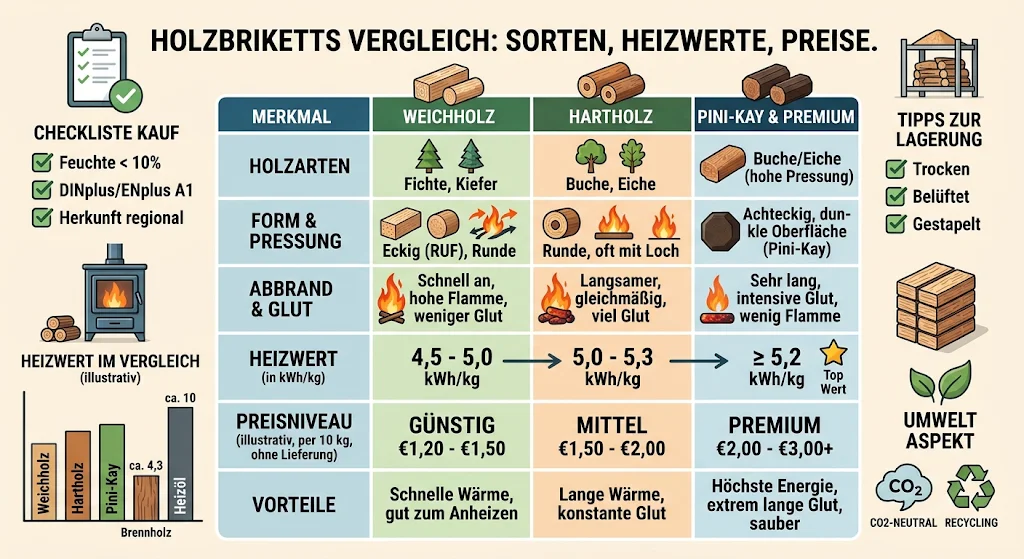
Pini Kay briquettes made from pure hardwood deliver the highest calorific value of all common briquette formats, at up to 5.5 kWh/kg.
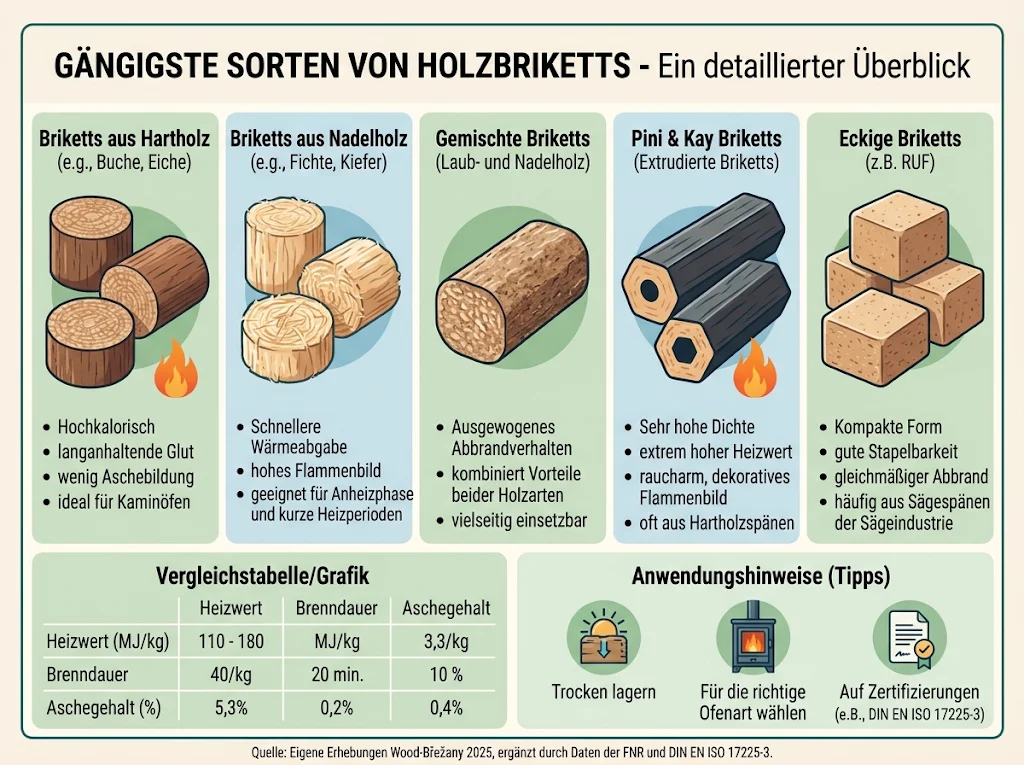
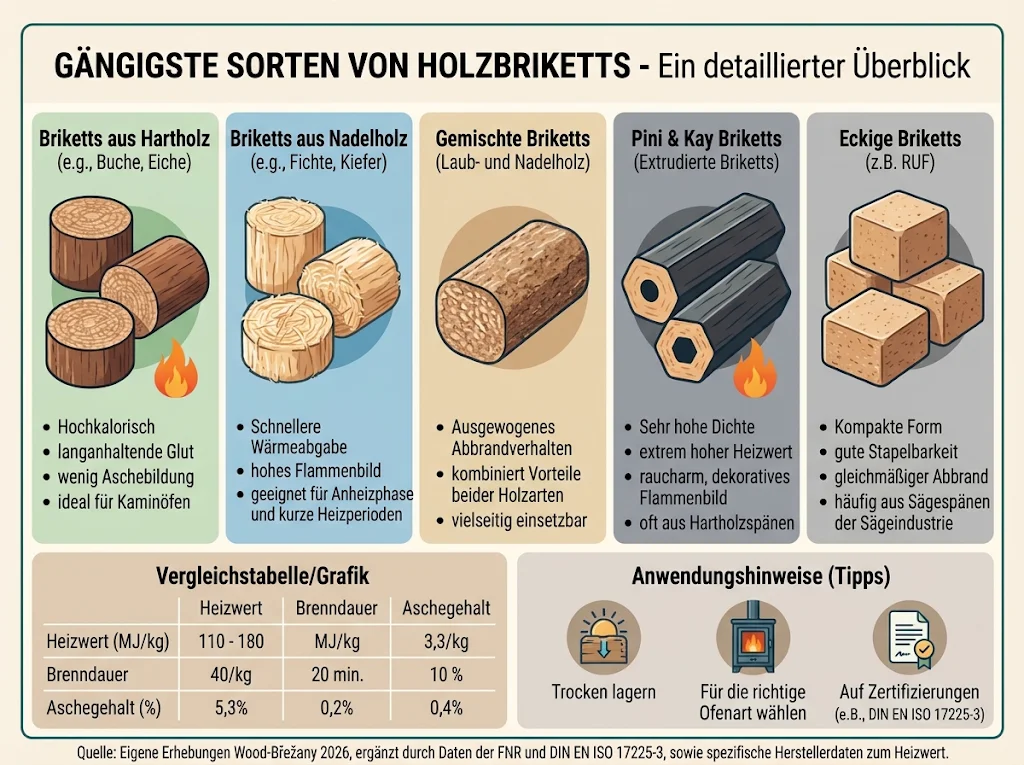
Not every briquette shape burns equally hot. The three most common types on the European market differ in pressing process, density and therefore also energy content:
RUF briquettes are formed into rectangular blocks under high pressure. They usually consist of sawdust and wood shavings and achieve a calorific value of approximately 4.8 to 5.2 kWh/kg. Our hardwood RUF wood briquettes regularly reach the upper end of this range.
Pini Kay briquettes are manufactured by extrusion with additional heat treatment. The outer layer is slightly charred, making the briquettes more moisture-resistant. At 5.0 to 5.5 kWh/kg, they offer the highest calorific value among common briquette types. Buying Pini Kay briquettes means choosing the most energy-rich variety.
Nestro briquettes are cylindrical and pressed from finer wood particles. Their calorific value is around 4.5 to 5.0 kWh/kg. They burn evenly and are well suited to smaller stoves. Our Nestro wood briquettes deliver consistent values throughout the burning period.
| Briquette type | Wood species | Calorific value (kWh/kg) | Residual moisture | Burning time | Density (kg/m³). |
|---|---|---|---|---|---|
| RUF hardwood | Beech, oak | 5.0 to 5.2 | 6 to 8% | 2 to 3 hours | 1,000 to 1,200 |
| RUF softwood | Spruce, pine | 4.5 to 4.8 | 7 to 10% | 1.5 to 2 hours | 800 to 1,000 |
| Pini Kay | Beech, oak | 5.0 to 5.5 | 5 to 8% | 2.5 to 4 hours | 1,100 to 1,300 |
| Nestro | Mixed wood | 4.5 to 5.0 | 7 to 10% | 1.5 to 2.5 hours | 900 to 1,100 |
| RUF bark | Softwood bark | 4.2 to 4.6 | 8 to 12% | 2 to 3 hours | 900 to 1,050 |
According to a 2024 analysis by the German Pellet Institute (DEPI), the average calorific value of wood briquettes traded in Germany is 4.9 kWh/kg.
How does the calorific value of wood briquettes differ from firewood?
Wood briquettes seem to give more energy than regular logs. Something like 4.5 to 5.5, compared to around 3.5 to 4.2. I think the main reason is how much water is still in the wood after drying.
Logs that have been sitting around for a year or two still have quite a bit of moisture left. Maybe 15 to 20 percent. That water has to turn into steam before the wood can actually burn and give off heat, which takes away from the total energy you get out of it.
Briquettes are different because they get dried out more when made from shavings. They end up with less moisture overall. So it feels like you get more of the heat from the wood itself going into the stove instead of being wasted on evaporation.
The difference shows up in how much energy they provide per kilogram. But I am not totally sure how this all adds up in practice with different stoves.
Anyone wanting to calculate the exact cost comparison between wood briquettes and firewood will find a detailed comparison in our article on wood briquettes or firewood by calorific value and price.
Why do wood briquettes have a higher calorific value than logs?
Their low water content of just 6 to 10 per cent and high compression provide significantly more usable energy per kilogram.
Two physical factors make the difference:
- Low residual moisture. Logs retain considerable amounts of water even after prolonged storage. For wood briquettes, the raw material is dried to below 10 per cent moisture before pressing.
- High compression. Pressing pressure of up to 1,500 bar compresses the wood fibres so tightly that there is more combustible material per unit of volume. A wood briquette weighs approximately twice as much as a log of the same size.
The result: less water, more wood mass and more heat per kilogram.
How Wood Briquette Heat Output and Energy Content Work
Wood briquette energy content is the total amount of energy stored in the briquette. Wood briquette heat output is the amount of that energy released as usable heat while the briquette burns.
1. Wood briquette energy content
Energy content is usually measured in:
- kWh/kg
- MJ/kg
- BTU per pound
Good-quality, dry wood briquettes commonly provide approximately 4.5–5.5 kWh of energy per kilogram, although the exact value depends on the wood type, density, moisture level, and manufacturing process.
For example:
- 1 kg of briquettes at 5 kWh/kg contains approximately 5 kWh of stored energy.
- 10 kg contains approximately 50 kWh of stored energy.
This is the fuel’s theoretical energy before combustion losses.
2. Wood briquette heat output
Heat output refers to how quickly and efficiently that stored energy becomes useful heat. It depends on:
- Briquette moisture content
- Density and size
- Airflow in the stove or boiler
- Appliance efficiency
- Burning rate
- Storage conditions
If a stove operates at 80% efficiency, 1 kg of briquettes containing 5 kWh of energy may deliver approximately:
[ 5 \times 0.80 = 4 \text{ kWh of useful heat} ]The rest is lost through the chimney, exhaust gases, incomplete combustion, or heating the appliance itself.
3. Why moisture matters
Moisture reduces useful heat output because part of the combustion energy is used to evaporate water inside the fuel. Dry briquettes generally:
- Burn hotter
- Produce more consistent heat
- Burn more efficiently
- Create less smoke
- Provide better value per kilogram
4. Heat output versus burning time
A briquette that burns quickly may produce a high heat output for a short period. A denser briquette burned slowly may provide steadier heat for longer.
Therefore, the best briquette is not always the one with the highest immediate flame. For home heating, both energy content and controlled heat release are important.
Simple explanation
Energy content = how much energy the briquette contains.
Heat output = how much useful heat your appliance produces from that energy and how quickly it releases it.
For accurate comparisons, check the product’s laboratory data, including calorific value, moisture content, ash content, and recommended appliance type.
Where can you buy high-calorific-value wood briquettes in Germany?
We deliver high-calorific-value wood briquettes by the tonne and full truckload to your location in Germany and Austria.
At Wood-Břežany, you order wood briquettes directly from the supplier. We stock all common varieties and deliver from one tonne up to full truckloads. Our customers in Germany and Austria benefit from short delivery routes and consistent quality.
Those looking for smaller quantities will find them in our shop. We are happy to prepare individual quotations for bulk orders. Contact Wood-Břežany directly by phone or email.
How much heating energy do wood briquettes provide per tonne?
One tonne of wood briquettes produces between 4,500 and 5,500 kWh of heat, which makes them suitable to replace 500 litres of fossil heating oil completely.
The calculation process involves multiplying 1,000 kg by the energy range of 4.5 to 5.5 kWh/kg to produce a total of 4,500 to 5,500 kWh per tonne. The Federal Ministry for Economic Affairs and Climate Action states that a typical German detached house uses between 15,000 and 20,000 kWh of heating power every year. The yearly heating requirements of a properly insulated home need three to four tonnes of wood briquettes for fulfilment.
Frequently asked questions about the calorific value of wood briquettes
What is the calorific value of RUF wood briquettes made from beech?
RUF briquettes made from pure beech achieve a calorific value of 5.0 to 5.2 kWh/kg with residual moisture below 8 per cent.
Do wood briquettes burn longer than wood pellets?
Yes, wood briquettes generally burn longer than wood pellets because they have a higher density and greater individual weight. Burning time is 2 to 4 hours per briquette. Read more in our article on the burning time of wood briquettes.
Can you measure the calorific value of wood briquettes yourself?
No, reliable calorific-value measurement requires a laboratory calorimeter. For domestic use, checking the manufacturer’s data sheet and stated residual moisture is sufficient.
How does the calorific value of wood briquettes compare with lignite briquettes?
Lignite briquettes deliver approximately 5.0 to 5.5 kWh/kg, putting them in the same range as high-quality wood briquettes. However, burning lignite produces significantly more CO₂ and particulate matter.
Does storage affect the calorific value of wood briquettes?
Yes. If wood briquettes absorb moisture, their usable calorific value falls. Always store briquettes dry and ventilated. Our guide to RUF briquettes contains detailed storage tips.
Key findings
- Wood briquettes achieve a calorific value of 4.5 to 5.5 kWh/kg, depending on wood species and residual moisture.
- Hardwood Pini Kay briquettes offer the highest energy density of all common briquette shapes.
- Compared with logs, wood briquettes deliver up to 30 per cent more usable heat per kilogram.
- One tonne of wood briquettes replaces approximately 500 litres of heating oil.
- Dry storage is essential to maintaining calorific value over the long term.
Sources:
- Agency for Renewable Resources (FNR), “Basic Bioenergy Data for Germany 2024”, fnr.de
- German Pellet Institute (DEPI), “Quality Requirements for Wood Briquettes”, depi.de
- DIN EN ISO 17225-3:2021, “Solid Biofuels, Fuel Specifications and Classes, Part 3: Wood Briquettes”
- Federal Ministry for Economic Affairs and Climate Action (BMWK), “Energy Data: Complete Edition 2024”, bmwk.de
- C.A.R.M.E.N. e. V., “Overview of Calorific Values of Solid Biofuels”, carmen-ev.de
- Bioenergy Europe, “Statistical Report 2024”, bioenergyeurope.org
- Bavarian State Institute of Forestry (LWF), “Energy Wood from the Forest”, lwf.bayern.de
What calorific value do wood briquettes have? Which wood briquettes have the highest calorific value? Calorific value of wood briquettes compared with wood, wood briquette calorific value in kWh, calorific value of wood briquettes compared with oil , wood briquette heat output, wood briquette energy content, biomass briquette calorific value, briquette fuel efficiency, best wood briquettes for heating