

 Čeština
 Deutsch
 Română
 Polski
 Italiano
 Español
 Nederlands
 Magyar
 Slovenčina
 Slovenščina
 Hrvatski
Wood Pellet Moisture Content Explained: Why It Is the Biggest Factor in Heating Efficiency
Wood Pellet moisture content is the single most important quality measurement when you buy wood pellets online, yet it is the one specification that most buyers never check. According to a 2025 study published in Biomass Conversion and Biorefinery (Springer Nature), moisture content in tested ENplus A1 pellets ranged from as low as 3.3% to as high as 9.4%, showing that even within the same certification class, considerable variation exists. That range has a direct and measurable impact on the heat your boiler can deliver and the money leaving your wallet each month.
Understanding this one figure, before you place your next order, is one of the most practical steps any homeowner or facilities manager can take to cut heating costs.
What Is Wood Pellet Moisture Content and Why Does It Matter So Much?
Pellet moisture content is the percentage of water held within a compressed wood pellet, measured as a proportion of total weight. The higher this figure, the less actual wood fibre is present per kilogram, and the less energy each kilogram can release during combustion.
Moisture content has a significant effect on the thermo-chemical conversion of wood pellets. Over-high moisture content directly influences calorific value and heat efficiency.
Picture a freshly cut log beside one that has seasoned for two years. The seasoned log ignites faster, burns hotter, and leaves less residue. Pellets follow the exact same principle at a compressed, industrial scale. The energy required to evaporate water from a wet pellet comes directly from your fuel, not from heating your home.
Buying Wood Pellets online
Our EN Plus A1 wood pellets are produced with a moisture content below 10%, guaranteeing consistent heat output, cleaner burns, and maximum boiler efficiency. Sourced from certified European forests and compressed under high pressure, each pellet delivers reliable, cost-effective warmth for homes and commercial heating systems across the UK and Europe. Each batch is tested for moisture, ash content, and calorific value before despatch, so you receive exactly what you pay for. Order certified pellets online with fast tracked delivery to your door.
Which Moisture Level Should You Buy for Maximum Heating Efficiency?
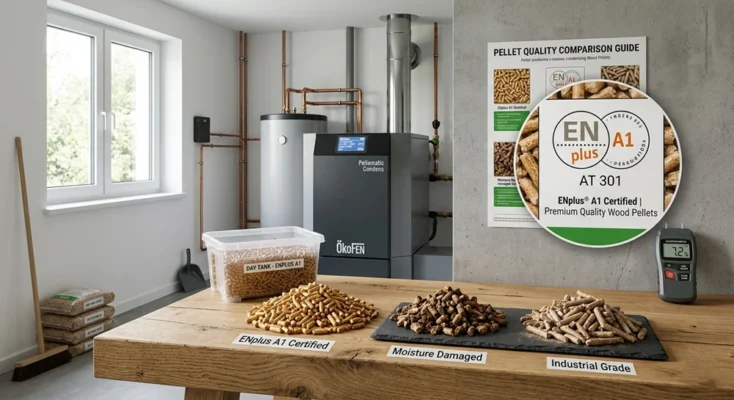
The ideal pellet moisture content for home and commercial heating is below 10%, with the best-performing A1 certified pellets typically testing between 5% and 8%.
Premium pellets contain less than 10% moisture. Low moisture means higher energy output, cleaner combustion, and less waste.
The table below summarises what each moisture band means for your system in practical terms:
| Moisture Content | ENplus Grade | Approx. Calorific Value | Ash Content Limit | Best Suited For |
|---|---|---|---|---|
| Below 8% | ENplus A1 | 4.6 to 5.0 kWh/kg | Max 0.7% | Residential boilers and pellet stoves |
| 8% to 10% | ENplus A2 | 4.4 to 4.6 kWh/kg | Max 1.5% | Larger commercial installations |
| 10% to 12% | ENplus B | 4.2 to 4.4 kWh/kg | Max 3.0% | Industrial heating systems |
| Above 12% | Off-specification | Below 4.0 kWh/kg | Uncontrolled | Not recommended for domestic use |
Source: ENplus Quality Standards, confirmed by Springer Nature Biomass Conversion and Biorefinery, 2025.
Our EN Plus A1 wood pellets are manufactured to consistently achieve sub-10% moisture, with most batches falling below 8%. You can verify our product data sheets and certification numbers on every order.
How Does High Moisture Content Damage Your Boiler Over Time?
High moisture content in wood pellets causes incomplete combustion, leading to faster boiler wear, more frequent maintenance, and measurably higher running costs.
High moisture content reduces boiler efficiency by 15 to 25%. High-moisture pellets require more frequent boiler cleaning, every 3 to 5 days instead of 1 to 2 weeks, along with higher maintenance costs and a reduced lifespan for the burner and auger feed system.
Three Direct Consequences of Burning Wet Pellets
- Reduced flame temperature. Moisture absorbs combustion energy during evaporation, lowering the effective burn temperature and forcing your boiler to run longer cycles to reach its set point.
- Excess ash and clinker formation. Excessive ash formation clogs heat exchangers, restricting airflow and reducing heat transfer efficiency across the entire system.
- Accelerated corrosion inside flue pipes. Water vapour produced when wet pellets combust condenses at lower flue temperatures, creating acids that corrode internal metal components over time.
“Moisture is the enemy of efficient biomass combustion. Every percent above 10% represents energy you are paying for but not receiving as useful heat.” (Paraphrased from ENplus Quality Standards guidance, 2024.)
The long-term financial consequence is significant. A household burning 4 tonnes of pellets per heating season at 14% moisture instead of 8% loses approximately 2,400 kWh of usable heat per season, based on a calorific deficit of roughly 0.6 kWh per kilogram. That is energy you have already paid for but never received.
Best EN Plus A1 Wood Pellets for Sale: What the Certification Actually Guarantees
When you order certified wood pellets carrying the ENplus A1 label, you receive a product that has been tested by an accredited independent laboratory. ENplus A1 certification is administered by the European Pellet Council and includes strict production, labelling, and distribution standards across the entire supply chain. To qualify, producers and traders must undergo regular audits and independent laboratory testing.
The full ENplus A1 specification covers:
- Moisture content: Maximum 10% (most A1 pellets test at 5% to 8%)
- Ash content: Maximum 0.7% of dry weight
- Diameter: 6mm or 8mm (tolerance of plus or minus 1mm)
- Durability: Minimum 97.5% resistance to breakage during transport
- Calorific value: Minimum 4.6 kWh per kilogram
- Sulphur content: Maximum 0.03%
For a side-by-side breakdown of all three grades, our ENplus A1 vs A2 vs B pellets comparison covers every parameter with practical guidance on which grade your appliance requires.
We also recommend reading our detailed wood pellet grades comparison resource, which explains how to read batch certificates and what each figure means for your heating performance.
Why Pellet Moisture Content Directly Controls Your Annual Heating Bill
The connection between moisture content and heating cost is linear and predictable. Lower moisture equals higher calorific value per kilogram, which means you burn less fuel to achieve the same indoor temperature.
Under optimal storage conditions maintaining humidity below 60% with stable temperatures, premium ENplus A1 pellets deliver consistently superior performance. Pellet prices typically range from 250 to 400 EUR per tonne in 2025, with certified A1 pellets commanding higher prices reflecting superior quality. However, they deliver better value through improved efficiency and reduced maintenance requirements.
Our comprehensive wood pellets guide for 2026 provides a full cost-per-useful-kilowatt-hour breakdown, helping you compare products on energy delivered rather than price per tonne alone. That distinction matters enormously when evaluating competing suppliers.
For those assessing the broader economics of pellet heating, our pellet vs gas heating cost comparison offers a detailed analysis based on 2025 to 2026 European energy prices.
How Improper Storage Raises Pellet Moisture Content After Delivery
Even perfectly dry A1 pellets absorb moisture quickly if stored in the wrong conditions. At 70% ambient humidity, pellets begin to absorb moisture from the surrounding air, which destroys their structural integrity and reduces combustion performance.
Correct Storage Practices to Preserve Low Moisture Levels
- Store bags on pallets, never directly on concrete or damp floors
- Keep pellets in a ventilated, covered space with ambient humidity below 60%
- Seal opened bags completely if not using the full contents immediately
- Inspect bags for damage before accepting any delivery
- Avoid temperature fluctuations that cause condensation inside storage areas
Our dedicated wood pellet storage guide covers every aspect of preserving pellet quality from delivery day through to the final kilogram of the heating season.
How to Check Pellet Moisture Content Before You Buy or Accept Delivery
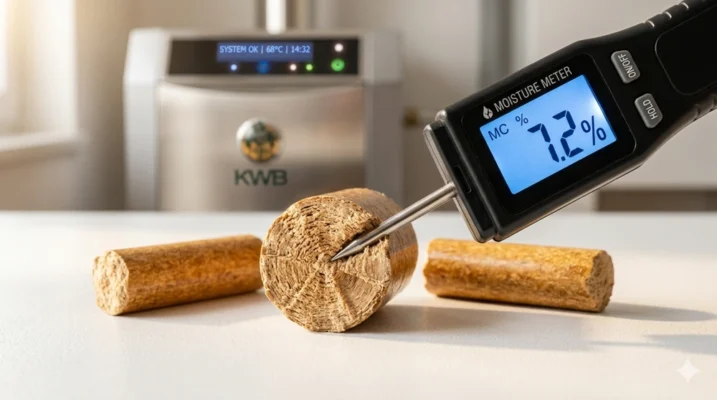
You can check pellet moisture content at home using a handheld wood moisture meter, available from most hardware retailers for between €18 and €47. Insert the probes into a pellet sample after breaking it apart, and take readings from several pellets across different parts of the bag.
What a Quality Certificate of Analysis Should Include
A trustworthy supplier will provide a product data sheet or full certificate on request. Look for the following confirmed values:
- Moisture content result (below 10% for A1)
- Test method reference (ISO 18134 for biomass moisture measurement)
- Ash content at 550°C (below 0.7% for A1)
- Net calorific value (above 4.6 kWh/kg for A1)
- ENplus producer certification number (verifiable on the official ENplus registry)
At Wood Břežany, we provide full documentation on request for every product in our range. Visit our about us page to learn about our sourcing standards and production process, or contact our team directly via the contact page with any technical questions.
Where to Order the Best Low-Moisture Wood Pellets Online Across Europe
We supply certified low-moisture wood pellets to customers across the UK, Germany, Romania, Czech Republic, Poland, and the wider European Union. Every product in our online shop carries clear moisture and calorific value specifications so you can purchase with confidence.
UK customers can buy wood pellets near them with fast delivery, whilst European buyers will find our full range at woodbrezany.com/en/buy-wood-pellets. Our FAQ page answers the most common questions about grades, delivery, and storage.
Looking for further reading? Our guide on how wood pellets are made explains the production and drying process that determines final moisture content at the factory level.
Key Takeaways
- Pellet moisture content is the primary technical factor controlling heating efficiency and fuel costs.
- According to the ENplus standard, the moisture content of qualified wood pellets must be lower than 10%.
- Every percentage point of moisture above 10% reduces calorific value and increases annual running costs.
- High-moisture pellets can reduce boiler efficiency by 15 to 25% and significantly increase maintenance frequency.
- Correct post-delivery storage is as important as the pellet specification itself.
- Always request a certificate of analysis and verify the ENplus certification number before committing to a supplier.
- Our EN Plus A1 wood pellets are tested, certified, and documented, giving you complete confidence in every order.
Wood Pellet Moisture Content
What is the ideal moisture content for wood pellets used in home heating?
The ideal pellet moisture content for home heating is below 10%, with the best A1 certified products testing between 5% and 8%. Pellets within this range produce the highest calorific output, the least ash, and cause the least wear on boilers and pellet stoves.
How does pellet moisture content affect heating efficiency?
High moisture forces the boiler to use combustion energy evaporating water before the fuel can actually burn. This lowers flame temperature, increases ash production, and reduces the usable heat output per kilogram paid for, directly raising your heating bills throughout the season.
Can I test pellet moisture content at home without specialist equipment?
Yes. A handheld wood moisture meter, which costs between €18 and €47 at most DIY retailers, provides a reliable reading when probes are inserted into a broken pellet sample. Test several pellets from different parts of the bag and average the readings for accuracy.
What is the difference between ENplus A1 and A2 in terms of moisture content?
Both grades share the same maximum moisture limit of 10% under the ENplus standard. The practical distinction lies in ash content: A1 pellets must produce no more than 0.7% ash, whilst A2 allows up to 1.5%. For residential boilers and pellet stoves, A1 is the correct and recommended choice. Our full ENplus A1 vs A2 vs B pellets comparison explains each grade in detail.
Does storing wood pellets incorrectly increase their moisture content?
Yes, significantly. Pellets are hygroscopic, meaning they readily absorb ambient moisture. Storing bags on bare concrete, in unventilated spaces, or in conditions above 60% relative humidity can raise moisture content enough to measurably reduce calorific value and cause pellets to swell or crumble before use.
Why do some cheaper pellets have higher moisture content than certified ones?
Lower-cost pellets are often produced with less rigorous raw material drying. Without mandatory ENplus third-party auditing, there is no independent check on moisture levels before the product leaves the factory. The lower purchase price is frequently offset by higher fuel consumption and increased boiler maintenance costs over the season.
How much can switching to low-moisture A1 pellets save per heating season?
Based on a typical annual consumption of 4 tonnes in a well-insulated 3-bedroom home, switching from 14% moisture pellets to certified A1 pellets below 8% moisture recovers approximately 2,400 kWh of usable heat per season. At current European pellet prices and electricity equivalents, that represents a meaningful saving in both fuel quantity and maintenance costs.
References
- Mack, R., Schön, C., Kuptz, D. et al. (2025). Quality range of ENplus A1 certified wood pellets and their combustion behavior in residential pellet stoves and pellet boilers. Biomass Conv. Bioref. 15, 17155–17171. https://doi.org/10.1007/s13399-024-06346-y
- ENplus Quality Standards for Wood Pellets, European Pellet Council. https://www.enplus-pellets.eu/en-in/
- Balcas Energy. (2025). Wood Pellet Moisture Content. https://balcasenergy.com/wood-pellet-moisture-content/
- Balcas Energy. (2025). Why ENplus A1 Certification Matters When Buying Wood Pellets. https://balcasenergy.com/why-enplus-a1-certification-matters/
- Inflame.eu. (2025). ENplus A1 Standard for Wood Pellets: A Complete Guide to Quality and Certification. https://inflame.eu/en/blog/standart-enplus-a1-dlya-derevnih-pelet-povniy-gid-po-yakosti-ta-sertifikaciyi
- Wood-Břežany S.R.O. (2026). Wood Pellet Energy: Complete Guide for Europe. https://woodbrezany.com/en/wood-pellet-energy-complete-guide-europe/
- GEMCO Pellet Mills. Wood Pellet Specification and Standard. https://www.gemcopelletmills.com/wood-pellet-specification.html